Skip to main content Skip to main menu Skip to footer

Indicator: Agricultural nitrogen surplus

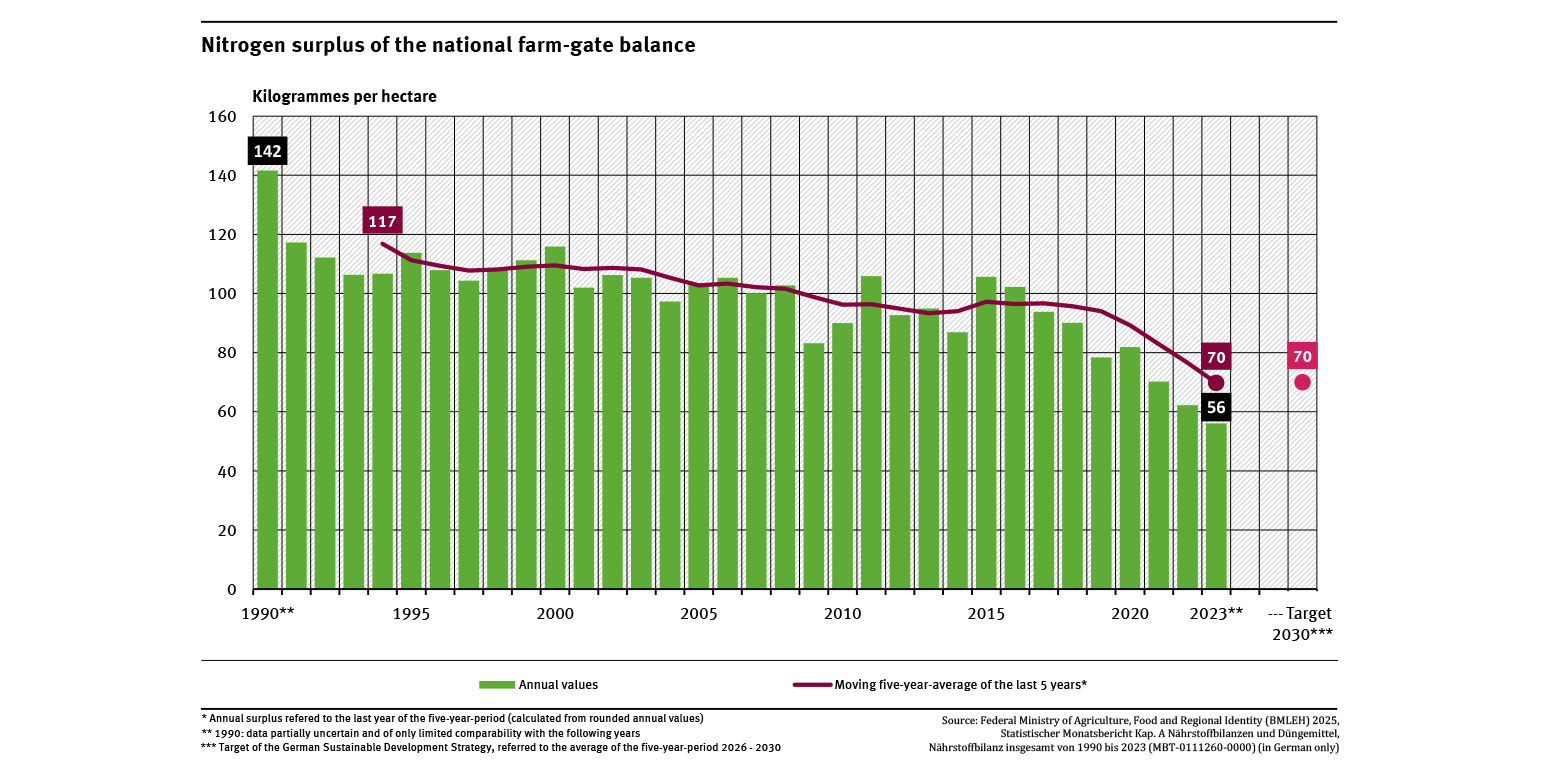
A graph shows the agricultural nitrogen surpluses for individual years and as rolling 5-year means between 1990 and 2023. The 5-year-mean nitrogen surpluses in kilogrammes per hectare dropped from 117 to 70. The target for 2026-2030 is 70 kilogrammes per hectare and year.
Nitrogen surplus of the national farm-gate balance
Source: Federal Ministry of Food and Agriculture

Table of contents

At a glance

  • The five-year average of nitrogen surplus of the total balance per hectare of utilized agricultural land has decreased by 40 % since 1994.
  • The Federal Government aims to reduce the average nitrogen surplus of the total balance of the years 2026 to 2030 to 70 kilogrammes per hectare of agricultural land.
  • The target was achieved for the first time in 2023.

Environmental importance

Nitrogen is an essential nutrient for all living organisms. However, excessive input of reactive nitrogen compounds to the environment has serious effects on the climate, biodiversity and landscape quality. For example, nitrogen which is not utilized by plants or is converted back into atmospheric nitrogen may lead to pollution of the groundwater, which is a significant source of drinking water, nutrient enrichment (eutrophication) of waterbodies, acidification of terrestrial ecosystems and the formation of greenhouse gases. An introduction to the issue of nitrogen surplus is given in the publication ’Reactive nitrogen in Germany‘ (UBA 2015).

In Germany problems occur especially in regions with high livestock density: Due to the high amount of farm manure (animal excrements), often more nitrogen is applied to the fields as the crops can convert into biomass. The nitrogen surplus is an indicator of the potential nitrogen losses from agriculture to the environment.

Assessing the development

Between 1994 and 2023, the 5-year average nitrogen surplus of the total balance per hectare of agricultural land decreased by around 40 %. Farmers are thus using fertilizers more efficiently and feed conversion by domestic animals has improved.

In recent years, the implementation of more effective agricultural fertilisation legislation, a reduction in animal numbers, as well as lower sales figures for mineral fertilisers due to stricter fertilisation requirements, years of drought and higher prices for mineral fertilizers have also had an impact. Due to the significant reduction in nitrogen surplus by more than 50 kg N/ha over the past seven years, the goal of the sustainability strategy to reduce the nitrogen surplus to 70 kg N/ha*a in a moving 5-year average by 2030 is being achieved for the first time.

However, achieving the goal of the German Sustainability Strategy does not mean that no additional efforts are needed to further reduce nitrogen inputs into the environment. Rather, this should be seen as a sub-goal on the path to protecting the environment, health and climate from the effects of excessive nitrogen inputs. The need for further action to reduce nitrogen in the environment is shown by the indicators like 'Nitrate in groundwater' and 'Nitrogen eutrophication', which are closely linked to the nitrogen surplus and do not indicate any positive trends.

Methodology

The nitrogen surplus is determined from the total agricultural nitrogen balance for Germany. It is the difference between the input (e.g. fertiliser, feed, seed and seedlings, atmospheric inputs) and the output (animal and plant products) of the national farm-gate balance. The data are calculated by the Julius-Kühn-Institute and the German Environment Agency and are published annually by the BMLEH (BMLEH 2025, Statistischer Monatsbericht, MBT-0111260-000) (in German only)). Hints to the calculation method can be found in Müller et al. 2024 (in German only) and Häußermann et al. 2019 (in German only). In order to adjust for annual fluctuations a five-year moving average is calculated. Since 2025, the target value of the German Sustainability Strategy refers to the last year of the five-year period.

More detailed information: 'Stickstoffeintrag aus der Landwirtschaft und Stickstoffüberschuss' (in German only).

Related contents

Tags

Short link: https://www.uba.de/n38751en