
Permitting research projects on marine geoengineering
The German Environment Agency (UBA) is the enforcement authority for scientific projects in marine geoengineering. Marine geoengineering refers to targeted interventions in the seas to mitigate climate change, such as through methods for CO₂ removal. The legal basis for this is the German “Hohe-See-Einbringungsgesetz” (Article 8 para. 3 HSEG).
Responsibilities for the approval and monitoring of activities (enforcement) in relation to marine waters are divided up in Germany depending on the marine zone. The federal states of Bremen, Hamburg, Mecklenburg-Western Pomerania, Lower Saxony and Schleswig-Holstein are generally responsible for the enforcement of environmental law on land and in coastal waters, for example in the areas of water law, nature conservation law and pollution control. The Federal Maritime and Hydrographic Agency (BSH), the Federal Agency for Nature Conservation (BfN) and the UBA, among others, are entrusted with enforcement tasks in the seaward adjacent waters. The UBA is also consulted and involved in the approval procedures of other authorities. Since July 2019, the UBA has been the enforcement authority for research projects on marine geoengineering.
The German "High Seas Dumping Act" (Hohe-See-Einbringungsgesetz, HSEG)
The overall objective of the German “Hohe-See-Einbringungsgesetz” (HSEG) is to protect the marine environment by regulating the dumping of waste and other matter in the high seas since 1998. The international basis for this is the London Protocol (LP), enshrined a general ban on discharges since 1996. Exceptions to this ban are only permitted for certain categories of waste and other matter.
In 2013, the contracting parties unanimously amended the LP to include regulations on marine geoengineering (Resolution LP.4(8)). This amendment was made in response to large-scale iron fertilization experiments in various regions of the high seas. The amendment to the LP establishes an assessment framework and recommends conducting independent international reviews (see Resolution LP.4(8), Annex 5). Under international law, the amendment will only take effect once it has been ratified by two-thirds of the contracting parties. Germany has already incorporated this amendment into national law (ratification on December 4, 2018).
The revised regulation in the HSEG permitted the introduction of substances as part of research projects on marine geoengineering, provided that it serves to enhance primary production, i.e., ocean fertilization. Other marine geoengineering methods in research projects, such as alkalinisation, as well as any commercial marine geoengineering projects, are prohibited under the current regulation.
Amendment to the High Seas Deposit Act: Adjustment of the legal framework
With the Federal Climate Protection Act, Germany has committed itself to achieving greenhouse gas neutrality by 2045 and negative emissions after 2050. This goal requires not only a significant reduction in greenhouse gas emissions, but also processes for the permanent removal and storage of carbon dioxide. The draft bill to amend the HSEG is part of a legislative package with which the Federal Government has committed itself in the coalition agreement to enable the capture, transport and storage of CO₂ under the seabed.
The HSEG currently prohibits the dumping of waste and other substances into the sea. In order to legally enable the offshore storage of CO₂ in the Exclusive Economic Zone (EEZ) and its export to other countries, amendments to the HSEG are therefore necessary. At the same time, domestic implementation of laws amending the HSEG and Article 6 of the London Protocol is taking place. Germany will ratify the relevant resolutions from 2009 (Resolution LP.3(4)) and 2019 (Resolution LP.5(14)); the necessary treaty law was submitted in parallel by the Federal Cabinet. The draft bill to amend the HSEG provides for the following in particular:
Enabling CO₂ storage in the German Exclusive Economic Zone (EEZ) through an explicit exemption from the general prohibition on dumping;
Establishing a general export ban on wastes and substances, with the exception of exporting CO₂ to other states for storage beneath the seabed;
Expanding the permissible marine geoengineering measures for research purposes. The planned measures include: ocean alkalinity enhancement, biomass sinking, CO₂ injection into the oceanic crust, and artificial upwelling;
Creating a clearer legal framework for the use of dispersants in cases of ship accidents.
The UBA as an enforcement authority
Hhe UBA is the competent authority for granting permits for marine geoengineering activities in Germany (Article 8 Abs. 3 HSEG). The scope of the Act covers activities under German jurisdiction in all marine waters (high seas), with the exception of the territorial sea under German sovereignty and the territorial seas under the sovereignty of other states (Article 2 para. 1 HSEG). This means that scientific projects carried out as part of marine geoengineering (see Annex to the HSEG) in the German EEZ, as well as in the EEZs of other states and on the high seas, require approval by the UBA, insofar as they fall under German jurisdiction.
At the same time, the UBA monitors the proper implementation of the approved research projects.
Information on the approval process for applicants
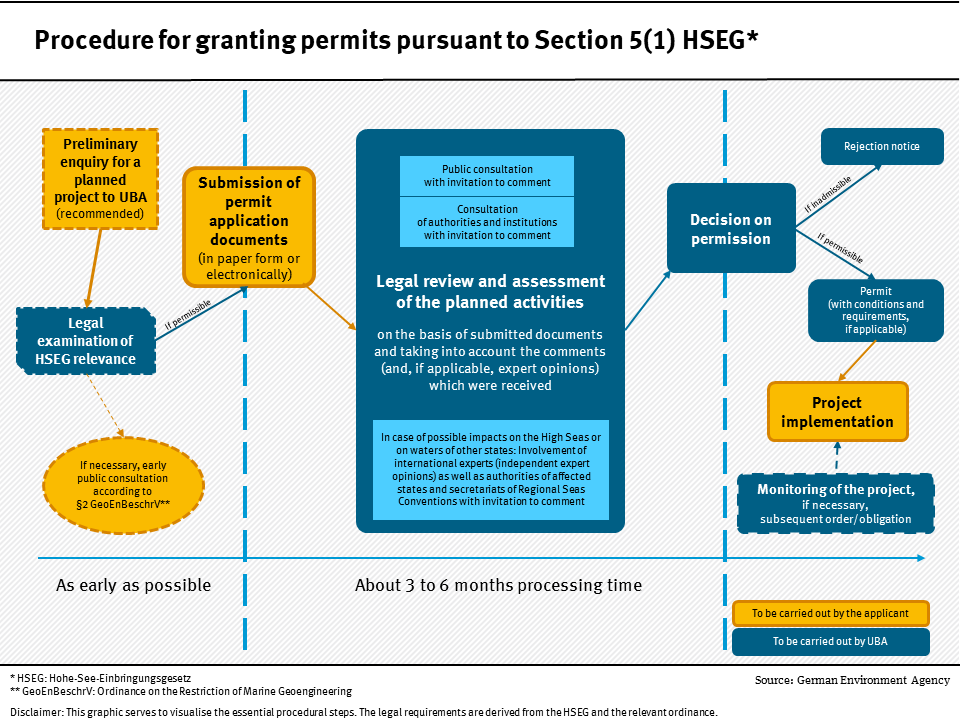
An application for the approval of a marine geoengineering project must be submitted in written form, either in paper or electronically (via hseg(at)uba.de), to the UBA. According to the regulation on the limitation of marine geoengineering (Article 3 para. 2 GeoEnBeschrV), the application documents must provide a detailed description of the reason for the project, the planned work phases, and the timeline of the project. In addition, the characteristics of the substances or objects to be inserted and the expected effects must be described in detail. For more information, see Article 3 GeoEnBeschrV.
The procedure in the HSEG approval process includes various participation processes. Source: German Environment Agency
The UBA recommends submitting a preliminary inquiry at an early stage when planning a scientific project on marine geoengineering. This allows for a timely assessment of the project's relevance under the HSEG and provides guidance on necessary steps, such as public participation (Article 2 GeoEnBeschrV).
Please note:
For the purpose of observing (monitoring) the affected environment at the project site, project-specific and risk-appropriate continuous measurement campaigns must be planned as part of the project and duly reflected in the financing plan. Due to the various national and international stakeholders involved, a processing time of up to six months should be expected. The respective state authorities are responsible for the implementation of scientific projects on marine geoengineering in coastal waters. The same requirements apply to the conditions for the approval of such projects as those under the HSEG (Article 45 Abs. 2 Wasserhaushaltsgesetz, WHG).
Further information on the legal basis can be found at Marine Protection Law (information is given in German).
The UBA’s motto, For our environment (“Für Mensch und Umwelt”), sums up our mission pretty well, we feel. In this video we give an insight into our work.
The UBA
Contact
Wörlitzer Platz 1 06844 Dessau-Roßlau GermanyPlease send us your enquiries exclusively via the contact form.
Due to the large number of enquiries, there may be delays in responding. We ask for your understanding.