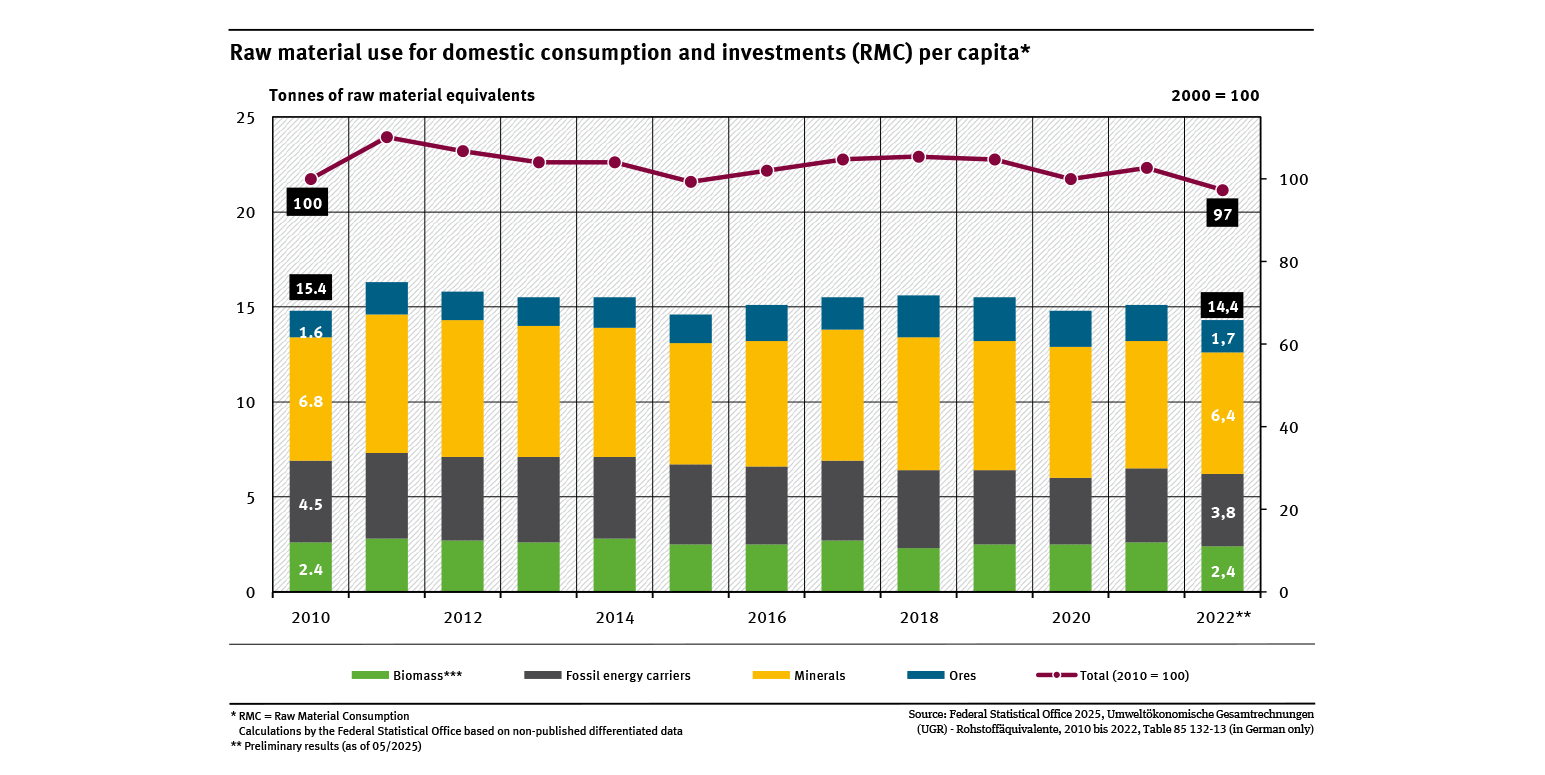
Per capita consumption of raw materials fluctuated slightly between 2010 and 2022. After an initial increase of 10 %, it remained slightly above the initial level. In 2022, per capita raw material consumption now stands at 97 % of the initial level marking the lowest value since 2010. There was a noticeable reduction of 0.7 tonnes per capita between 2019 and 2020, which is partly due to the restrictions imposed as part of the Covid-19 pandemic measures. In particular, there was a noticeable decline in investment demand in the economy. In contrast, demand for raw materials for consumption by the state and private non-profit organisations increased by around 10% between 2019 and 2021. This trend can also be seen in the raw material groups: Falling demand for fossil fuels (e.g. in transport) and metal ores (e.g. in mechanical engineering and vehicle construction) was offset by a relatively constant demand for mineral raw materials (e.g. construction activities of the state). From 2021 onwards, demand for fossil fuels rose almost back to pre-coronavirus levels, whereas consumption of mineral raw materials declined significantly. This is mainly due to a 6% drop in demand for mineral raw materials in the construction sector as a result of reduced construction activity in Germany. The recycling of waste is also relevant: This reduces the need for raw materials that need to be extracted from the environment and is counted towards raw material consumption. So far German and European policies have not set a quantitative target for raw material consumption. However, experts and the German Environment Agency believe that consumption of raw materials needs to be reduced considerably. In the National Circular Economy Strategy adopted in 2024, the German government took up this assessment and formulated a significant reduction in primary raw material consumption by 2045 as a guiding principle. A raw material footprint of 6-8 tons is considered an ambitious target value.