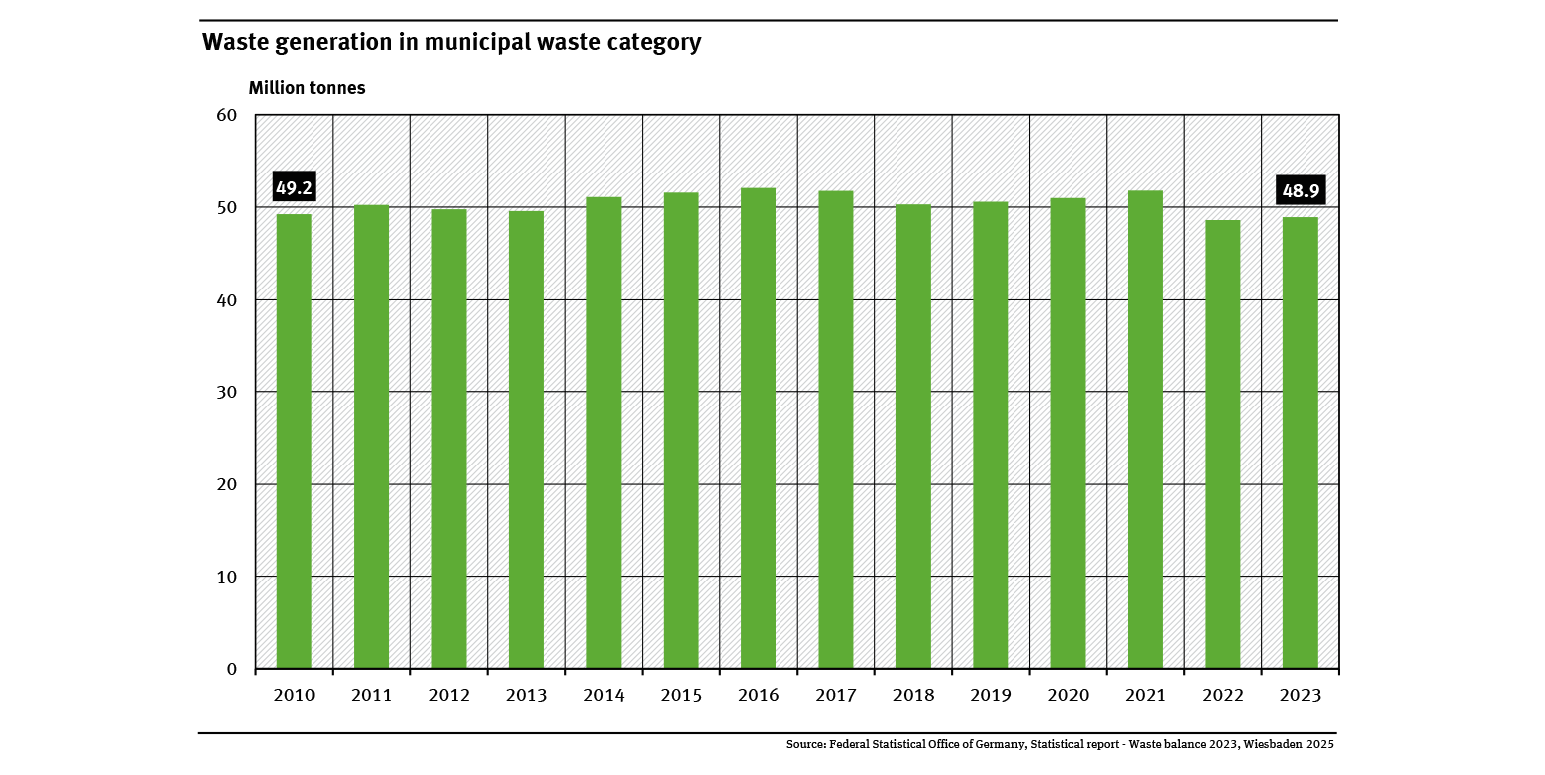
The amount of municipal waste has changed little in the period between 2010 and 2021: While it was still at 49.2 million tonnes in 2010, the peak was reached in 2016 at 52.1 million tonnes. In the following years, the volume of municipal waste remained at levels above 50 million tonnes. In 2022, the volume of municipal waste fell for the first time to 48.6 million tons, falling below the 2010 level (49.2 million tons) for the first time and remained below the 2010 level in 2023 at 48.9 million tons.
With the aim of strengthening waste avoidance, the federal government adopted a Waste Prevention Programme in 2013 with the participation of the states in accordance with Section 33 of the German Circular Economy Act (KrWG), which was updated in 2020. While the KrWG states that avoiding the generation of waste is the highest priority, the Waste Prevention Programme aims to decouple economic growth and waste volume: The amount of waste should grow at most as fast as the economy. While there was no decline in waste volumes in the period under review, a slight decoupling from economic growth can be observed: While the German economy grew by about 15.9 % between 2010 and 2021 (Federal Statistical Office, GDP price-adjusted), the amount of municipal waste increased by only about 5.9 %. In 2022, for the first time, municipal waste fell by 1.4 % compared to 2010. The decline of municipal waste remained on a similar level in 2023. Further efforts are required to effectively reduce waste volumes at all stages of the value chain.