
Electrical and electronic waste in Germany
In 2018 nearly 853,124 tons of electrical and electronic waste were collected in Germany, 772,934 of it from households. This is the equivalent of 9.31 kilograms per capita and year. The remaining 80,190 tons came from businesses.
Legal framework
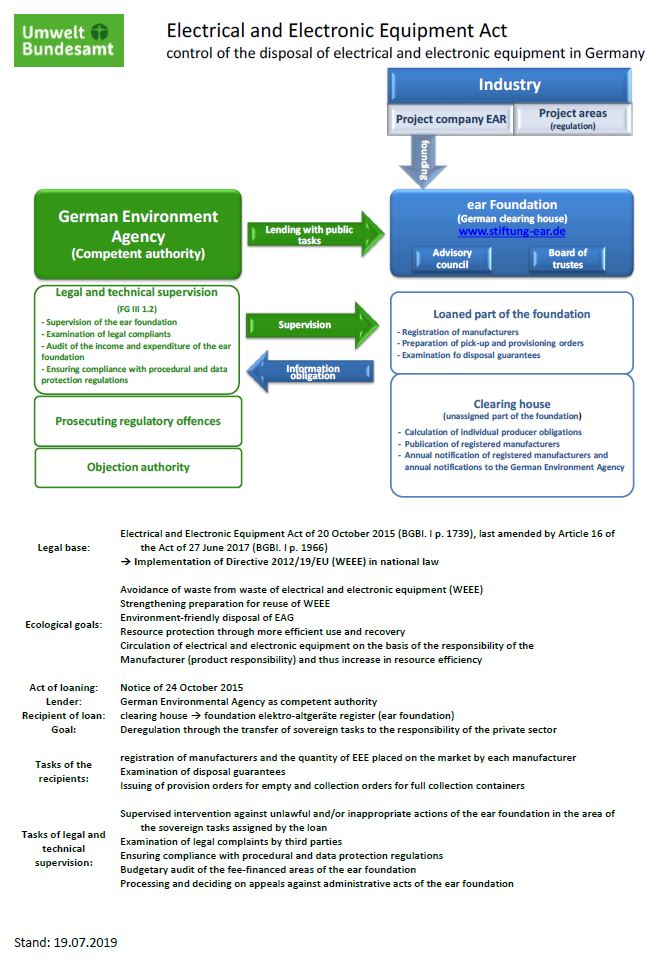
Proper disposal of electrical and electronic waste prevents pollution and allows this waste to be recycled. The WEEE Directive was adopted in 2003 for the purpose of instituting harmonized European regulations for electrical and electronic waste. The directive was transposed into German law via adoption of the 2005 Elektro- und Elektronikgeräte-Gesetz (ElektroG) law. An amended version of the directive, known as WEEE II, was enacted in July 2012. This directive was transposed into German law via the amended version of the ElektroG law.
A mechanism known as “divided product responsibility” was instituted in Germany for electrical and electronic waste disposal operations. This means that the main obligations for electrical and electronic waste disposal fall to (a) public sector recycling companies; and (b) electrical and electronic device manufacturers. Public sector recycling companies are required to establish electrical and electronic waste recycling centres and to accept such waste at these centres free of charge. This mechanism is currently carried out at around 2.400 municipal recycling centres. Manufacturers are free to provide their own recycling mechanisms. Since July 2016 retailers with a sale area for electrical and electronic equipment (EEE) larger than 400 square meters are obliged to take back EEE which has a smaller edge length than 25 centimeter (0:1 take back). In case of EEE larger than 25 centimeters the retailer is obliged to take back the old device, if the customer is buying a new equivalent type (1:1 take back). The same rules apply to long distance retailers with storage area larger than 400 square meters. They can, for example, offer free return options or cooperate with the stationary trade. Smaller retailers may also voluntarily take back EEE free of charge. Consumers are required by law to take their electrical and electronic waste to such facilities.
Manufacturers are responsible for properly disposing of the electrical and electronic waste that is brought to such facilities and bear the financial cost of product stewardship entailed by disposing of electrical and electronic devices that were placed on the market. In addition, the RoHS directive governs the use of certain environmentally hazardous substances in electrical and electronic devices. This directive was transposed into German law via enactment of the Elektrostoff-Verordnung regulation, which took effect on 9 May 2013 and places severe restrictions on the use of lead, mercury, cadmium, hexavalent chromium, polybromated biphenyls (PBB) and polybromated diphenyl ethers (PBDE) in new electrical and electronic devices.
Recycling
Upon being returned, electrical and electronic waste is sorted into six different collection groups, so as to better meet the requirements of the various devices in terms of recycling and handling. For example, large devices and battery operated devices are separated from small ones, so as to ensure that these are not damaged. Refrigerators are processed separately owing to the CFCs often contained in them. Besides gas discharge lamps are collected separately owing to the mercury contained in them.
Recycling procedures vary greatly from one type of product to another in certain cases. For example, the refrigerant and oil mixture is suctioned out of a refrigerator’s cooling circuit, the housing is shredded, and the gases in the housing insulation (including CFCs) are suctioned out and then disposed of harmlessly.
Fluorescent (energy saving) lamps are usually shredded and then undergo a wet or dry process, during which the mercury is suctioned out, passed through active charcoal filters, and then added to sediment sludge. This in turn allows for recovery of the mercury.
Computers, computer screens and TVs are first manually dismantled, whereby trained personnel remove pollutant containing components such as batteries, condensors, the background lighting of flat screens, some of them still contains mercury, or the cathode ray tubes of old tube televisions, which contain a lot of lead. Recyclable components such as printed circuit boards (PCB) are then removed, and the remaining components are shredded so as to allow for subsequent sorting into various types of materials. Automatic separation processes for the separation of components containing pollutants and recyclables are established in screen treatment.
This part of the recycling process yields many different types of sorted material. Recovered metals such as iron, steel, copper, aluminum and bronze are melted down to produce new metals. PCBs and elements such as plugs with gold-plated contacts are normally sent to copper foundries that specialize in the recovery of precious and special metals. As for sorted plastic, some is reused for energy, while some is recycled.
Collection and recovery rates for electrical and electronic waste
The WEEE directive sets targets for collection, recycling and recovery rates. Since 2006, Germany has been required to submit such rates to the European Commission.
Since 2016 the WEEE directive sets relative collection rates, whereby from 2016 to 2018 the target rate will be 45 percent of the average weight of electrical and electronic devices that were placed on the market in the prior three years. From 2019 onward, this target rate will be 65 percent. Germany’s collection rate in 2018 was 43.1 %.
The WEEE directive and Germany’s Electrical Products Act (ElektroG) also set specific recycling and recovery rates for various device classes. The target recovery rates for non-reusable devices range from 75 to 85 % depending on device class, whereas the target recycling rates for such devices range from 55 to 80 %. Germany has complied with all of these rates since 2007. In 2018 Germany kept all rates.