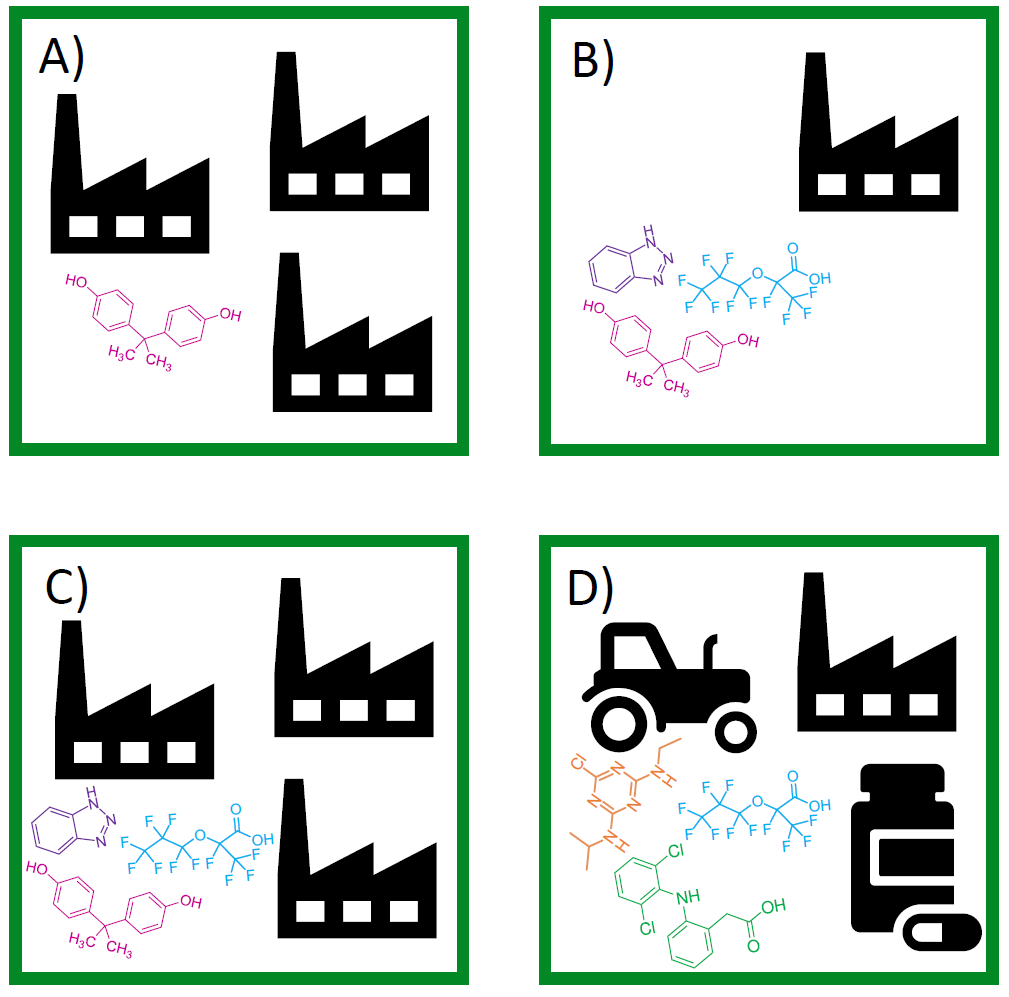
Figure 3: A) One substance from several sources, uses, e.g. products from different manufacturers (aggregated exposure); B) One registrant assesses several substances in a mixture; C) Mixture assessment: combined exposure and effect of different substances from different sources are taken into account. D) REACH could consider exposure of existing substances from other sources outside REACH (pharmaceuticals, biocides or pesticides). (Source: Hassold, Aust, Juffernholz, Leitner: "Chemical Mixtures & REACH: A starting point", SETAC GLB Landau 2011)
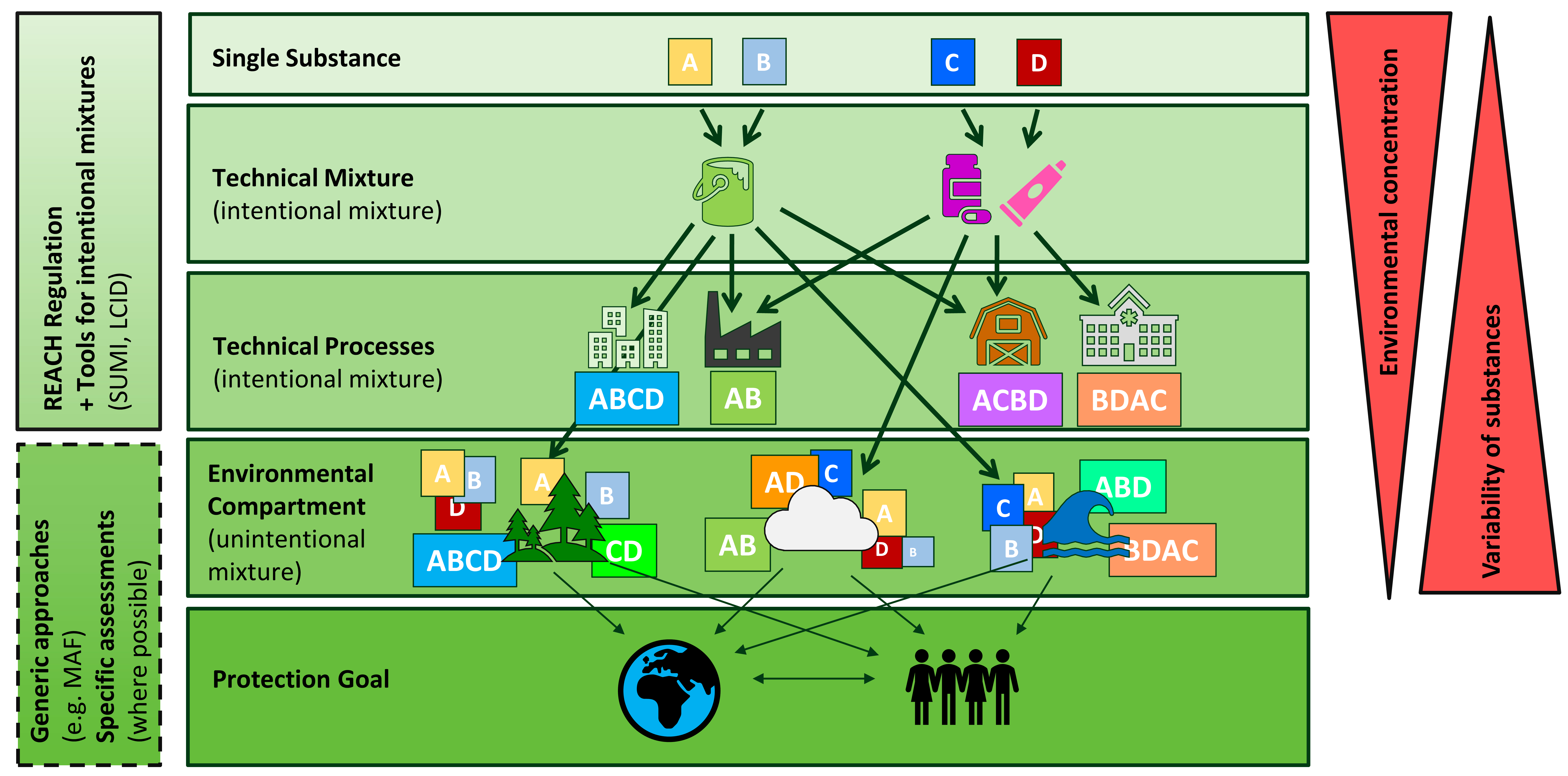
There are various approaches to move away from the current single substance assessment towards a better consideration of intentional and unintentional mixtures. UBA has evaluated these in several research projects.
A first step towards an improved assessment of chemicals is to take into account the release of a single chemical from several uses over the entire life cycle, the so-called aggregated exposure. A research project funded by the German Enviornemnat Agency (UBA) made several proposals for determining the aggregate total concentration of a substance in the environment (Groß et al. 2011).
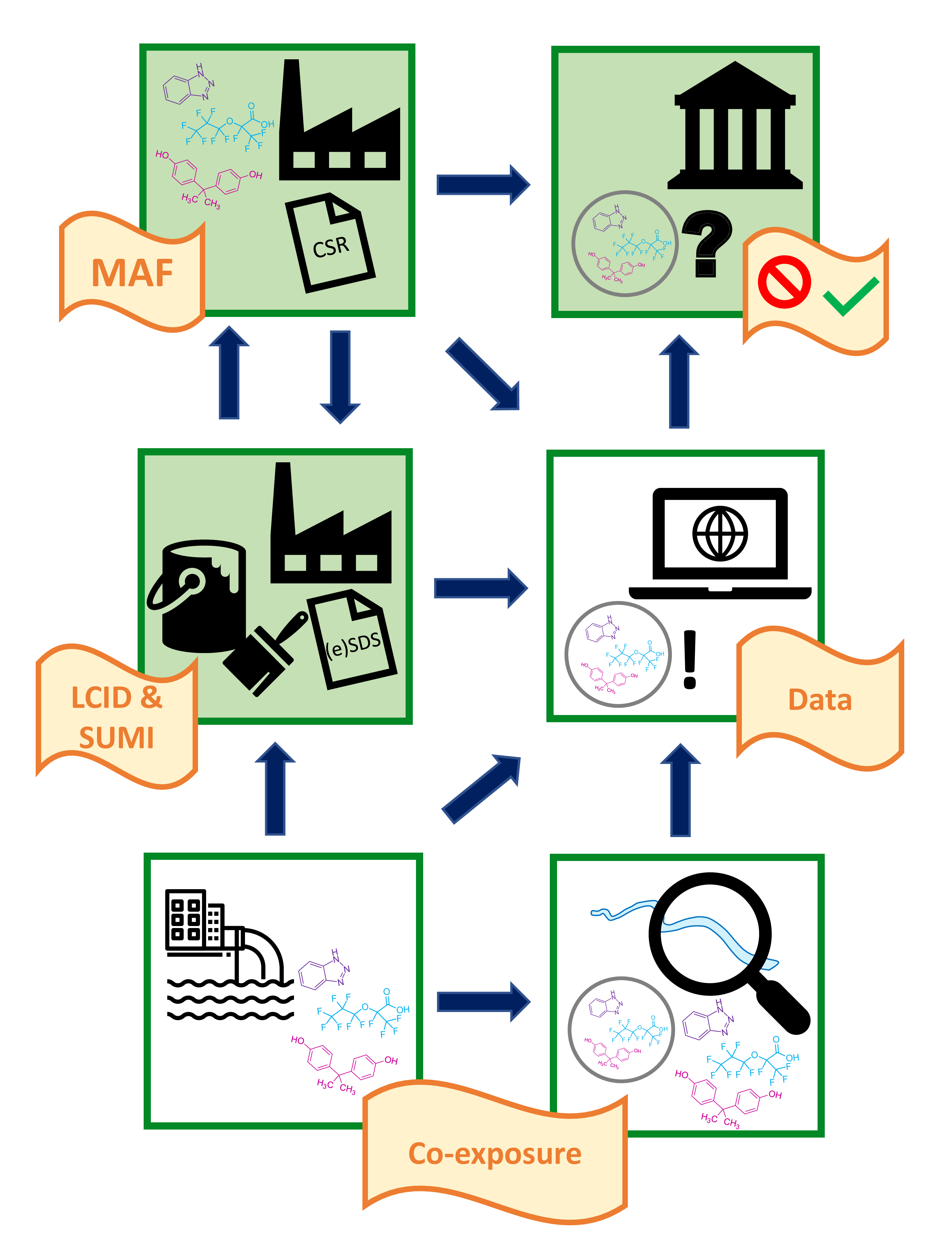
The composition of intentional mixtures is theoretically known to the user. In practice, however, information on the composition and properties of chemicals is often not shared along the complete supply chain and with all actors. Also, data on the release of the chemicals is very rarely available in a transparent way. In order to improve the communication of data for intentional mixtures along the supply chain, the industry associations VCI (German Chemical Industry Association) and CEFIC (European Chemical Industry Council) have proposed the so-called LCID (Lead Substance Identification) method and SUMI (Safe Use of Mixtures Information) (CEFIC 2016). The German Environment Agency sees opportunities for improving the assessment of mixtures (Reihlen et al. 2012, Galert & Hassold 2021).
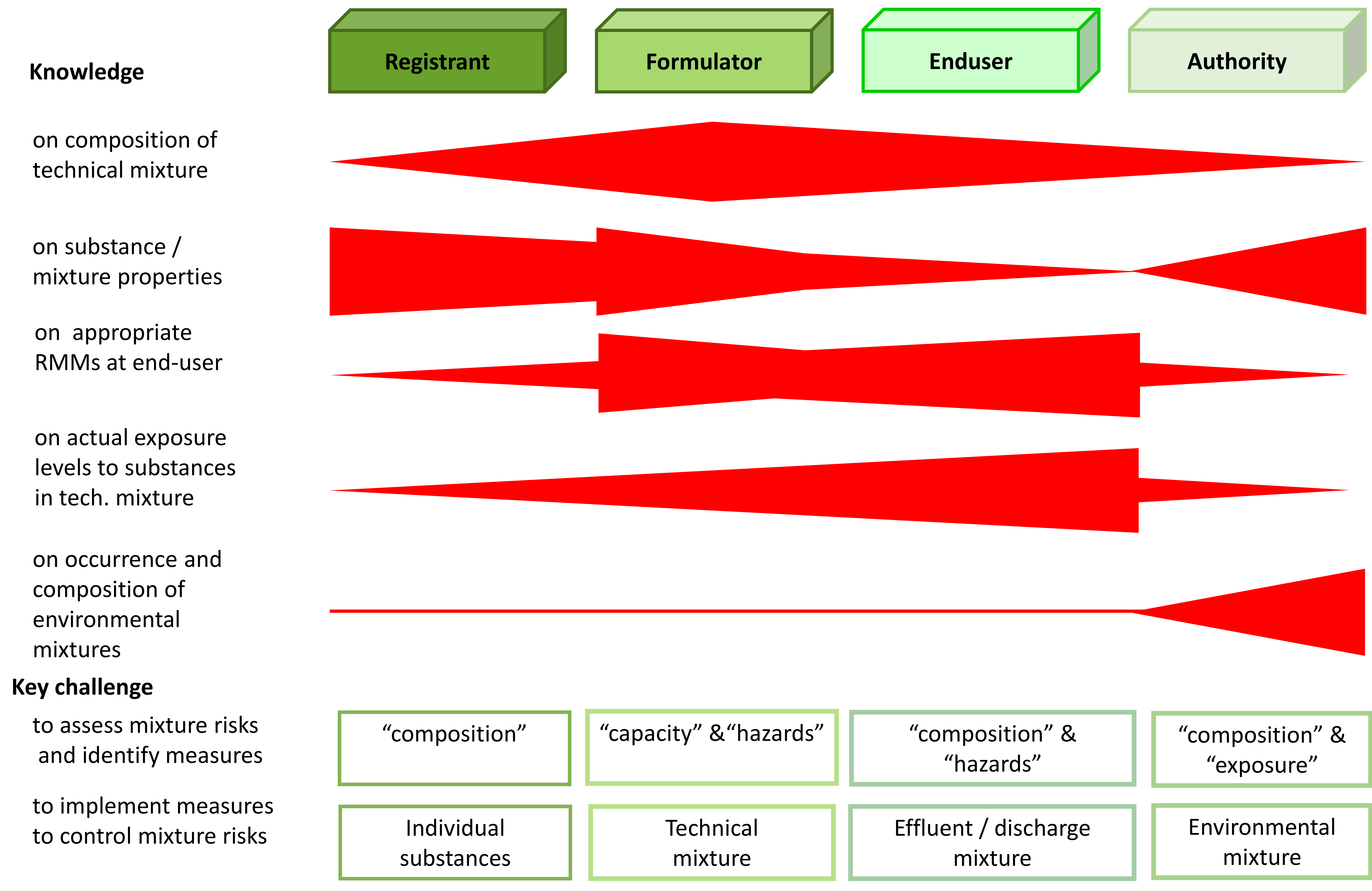
The possibilities for addressing unintentional mixtures were investigated in a research project initiated by UBA (Bunke et al. 2014). Specific assessments using existing concepts are theoretically possible for known and definable mixtures with sufficient data. This includes the prediction of mixture toxicity or a risk characterisation via summation of the individual risk quotients. The main challenges are the availability and communication of data on effects, exposure and the composition of complex mixtures. Furthermore, the responsibilities, tasks and information situation of the different actors vary (see Figure 4). This complicates the assessment of chemical mixtures by the registrant or user.
Figure 4: Simplified representation of the information availability for the different actors for the possible assessment of mixtures (source: Hassold et al. 2021).
Ultimately, all cooccurring substances falling under different regulation in the environment would have to be taken into account in the environmental assessment and, in addition to REACH chemicals, background contamination from pesticides, pharmaceuticals or biocides would also have to be considered.