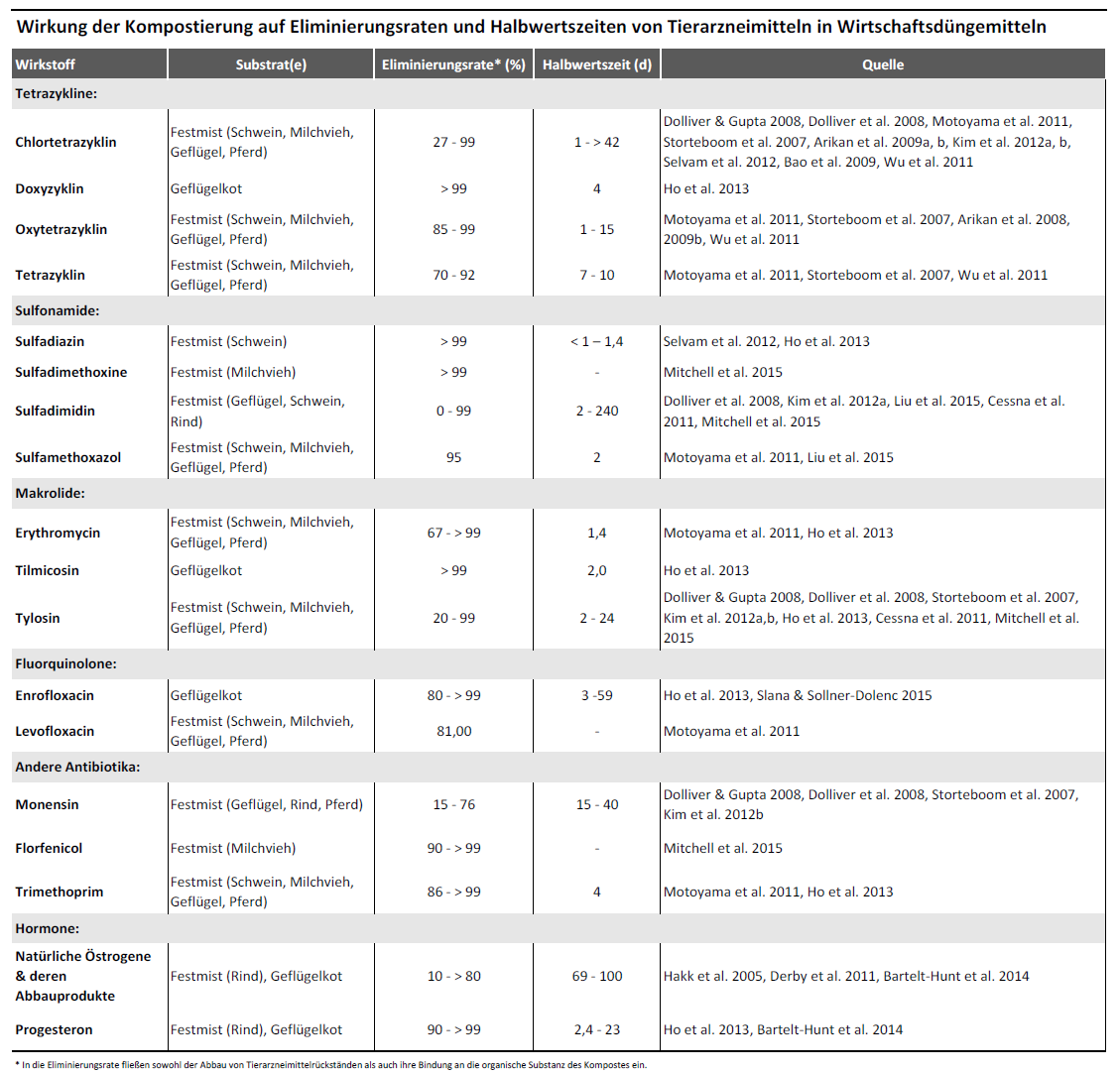
6. Eine Zusammenfassung der wissenschaftlichen Forschung zum Abbau einzelner Wirkstoffe in der Lagerung finden Sie in Kapitel 5 und in der Tabelle 10 (Anhang) von Vidaurre et al. (2016).
7. Carballa, M., Omil, F., Ternes, T., Lema, J.M. (2007). Fate of pharmaceutical and personal care products (PPCPs) during anaerobic diges-tion of sewage sludge. Water Research 41, 2139-2150.
8. Varel, V.H., Wells, J.E., Shelver, W.L., Rice, C.P., Armstrong, D.L., Parker, D.B. (2012). Effect of an-aerobic digestion temperature on odour, coliforms and chlortetracycline in swine manure or monensin in cattle manure. Appl. Microbiol. 112, 705–715.
9. Mitchell, S.M., Ullmann, J.L., Teel, A.L., Watts, R.J., Frear, C. (2013). The effects of the antibiotics ampicillin, florfenicol, sulfamethazine, and tylosin on biogas production and their degradation efficiency during anaerobic digestion. Bioresource technology 149, 244-252.
10. Arikan, O.A., Sikora, L.J., Mulbry, W., Khan, S.U., Foster, G.D. 2007. Composting rapidly reduces levels of ex-tractable oxytetracycline in manure from therapeutically treated beef calves. Technol. 98, 169–176.
11. Arikan, O., Mulbry, W., Ingram, D., Millner, P. 2009b. Minimally managed composting of beef ma-nure at the pilot scale: effect of ma-nure pile construction on pile temperature profiles and on the fate of oxytetracycline and chlortetracycline. Bioresource Technolo-gy 100, 4447-4453.
12. Arikan, O., Mulbry, W., Rice, C. 2009a. Management of antibiotic residues from agricultural sources: use of composting to reduce chlortetracycline residues in beef manure from treated animals. Journal of Hazardous Materials 164, 483–489.
13. Golet, E.M., Alder, A.C., Giger, W. 2002. Environmental exposure and risk assessment of fluoroquinolone antibacterial agents in wastewater and river water of the Glatt Valley Watershed, Switzerland. Environmental Science & Technology 36, 3645-3651.
14. Golet, E.M., Xifra, I., Siegrist, H., Alder, A.C., Giger, W. 2003. Environmental exposure assessment of fluoroquinolone antibacterial agents from sewage to soil. Environ. Sci. Technol. 37, 3243–3249.
15. Wang, Q.-Q., S.A. Bradford, W. Zheng, S.R. Yates, 2006. Sulfadimethoxine Degradation Kinetics in Manure as Affected by Initial Concen-tration, Moisture, and Temperature. J. Environ. Qual. 35, 2162–2169.
16. Aust, V. 2013. Verfütterung von unbehandelter und pasteurisierter Sperrmilch und Tankmilch an Aufzuchtkälber: Auswirkungen auf Gewichtsentwicklung, Tiergesundheit und antimikrobielle Resistenzmuster fäkaler Bakterien. Doktorarbeit. Bibliothek der Tierärztlichen Hochschule Hannover.
17. Bao, Y., Zhou, Q., Guan, L., Wang, Y. 2009. Depletion of chlortetracycline during composting of aged and spiked manures. Waste Management 29, 1416–1423.
18. Kim, K.R., Owens, G., Ok, Y.S., Park, W.K., Lee, D.B., Kwon, S.I. 2012a. Decline in extractable anti-biotics in manure-based composts during composting. Waste Manage. 32, 110–116.
19. Liu, B., Li, Y., Zhang, X., Feng, C., Gao, M., Shen, Q. 2015. Effects of composting process on the dissipation of extractable sulfonamides in swine manure. Bioresource technology 175, 284-290.