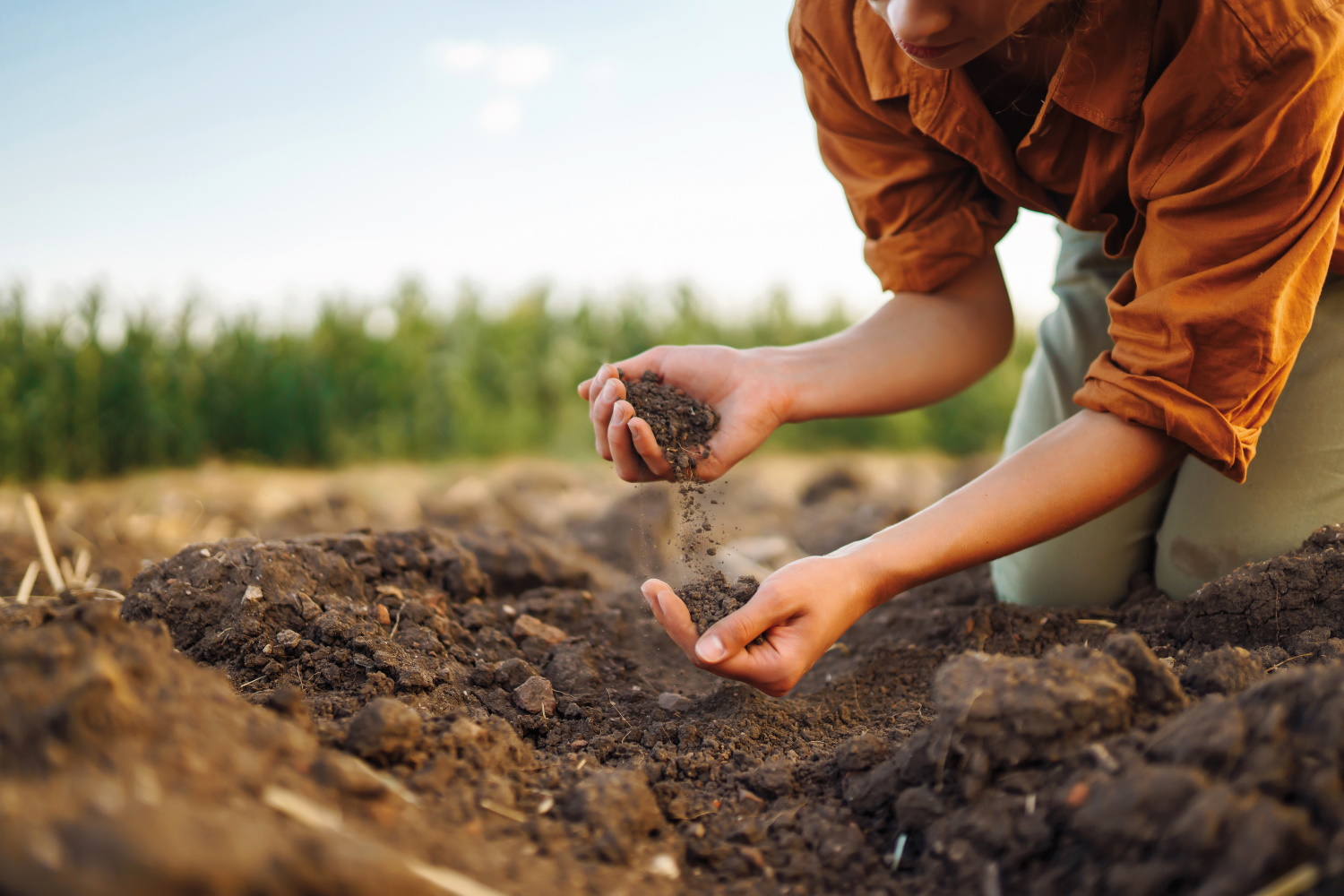
In terms of surface area, agriculture constitutes the most widespread intervention in natural soil structures, because more than half of Germany’s surface terrain is used agriculturally. As far as strengthening the resilience of soils is concerned, agriculture therefore plays a key role. In terms of adapting the agricultural use of soil, agricultural funding support is an important lever. With the ‘Greening’ of the European Direct Payments Regulation, which was in force from 2014 to 2022, support for agricultural enterprises under the Common Agricultural Policy (CAP) was made conditional on those enterprises having to contribute to environmental and climate protection. The Greening stipulations were also used to promote soil protection measures, such as the cultivation of catch crops. The previous Greening stipulations and the general ‘Cross Compliance’ obligations were consolidated to form the new ‘conditionality’ as of 2023. This new conditionality is now composed of two parts – the Statutory Management Requirements (GAB) and the compliance with standards for the maintenance of good agricultural and ecological condition (GLÖZ Standards). GLÖZ, on the other hand, encompasses further and, in part, stricter measures which, among other things, are intended to improve soil protection and the resilience of soils. Part of this is, for instance, the conservation of permanent grassland (cf. Indicator BO-R-2) and the safeguarding of minimum soil cover at the most sensitive times of the year, which includes the cultivation of catch crops. Both measures provide, above all, protection from erosion while also supporting humus production (cf. Indicator BO-R-1). Moreover, the EU member states are obliged, under the new CAP funding period, to voluntarily provide eco-regulations (ER); any beneficiary of this funding must invest part of their direct payments in these measures. The ER catalogue also includes measures intended to improve soil protection while contributing to climate change adaptation.
In principle, forests (including woodlands) are regarded as a soil-protecting type of use. On sites that are particularly at risk from erosion or from becoming overgrown, forests can be designated as soil protection woodlands or forests in order to safeguard permanent soil cover as well as root penetration. That notwithstanding, soil protection is ascribed increasing importance in respect of forest cultivation. The funding programme ‘Climate-adapted Forest management’ launched in 2022 by the BMEL also provides funding for measures targeting soil protection. This includes providing greater skid trail spacings to limit soil compaction, as well as forest enhancement by means of deadwood for humic enrichment (cf. Indicator FW-R-3). Soils can fulfil their important functions – in terms of ecosystems and in the interest of adaptation to climate change such as water storage and landscape cooling – only provided they are protected from overbuilding and sealing of surfaces (cf. Indicator RO-R-5). This is the reason why a reduction in land use conversion is not just a core sustainability objective, but also an objective pertaining to climate change adaptation. The German Sustainability Strategy updated by the Federal government in 202193 now intends for the daily increase in the conversion to residential and transport terrain to be reduced to less than 30 ha per day by 2030. The Integrated Environment Programme94 launched by BMUB in 2016, goes beyond this objective by setting 20 ha per day as an interim target for 2030, from the perspective that by 2050 the transition to circular land use will be completed, thus reducing the conversion of land use to net zero. However, to fulfil this objective will require substantially greater endeavours.
The Federal / Länder Working Group Soil Protection (LABO) coordinates the Länder’s concerns in respect of soil protection while also dealing with issues regarding climate change and its impacts on soil. With several position papers, LABO has taken a stand on important challenges, such as in 2017 with the position paper entitled ‘Significance and protection of peat soils’95 and in 2021 – jointly with LAWA – with the position paper ‘Degradation of soils – soil erosion by water’96.
94 - BMUB – Bundesministerium für Umwelt, Naturschutz, Bau und Reaktorsicherheit (Hg.) 2016: Den ökologischen Wandel gestalten – Integriertes Umweltprogramm 2030. Berlin, 127 pp. https://www.bmuv.de/publikation/den-oekologischen-wandel-gestalten.
95 - LABO – Bund/Länder-Arbeitsgemeinschaft Bodenschutz 2017: Bedeutung und Schutz von Moorböden. Positionspapier. Kiel, 3 pp. https://www.labo-deutschland.de/documents/171222_LABO_Positionspapier_Moorbodenschutz.pdf.
96 - LAWA – Bund/Länder-Arbeitsgemeinschaft Wasser, LABO 2021: Degradation von Böden – Bodenerosion durch Wasser. Positionspapier. München, 11 pp. https://www.lawa.de/documents/lawa-labo-positionspapier-degradation-von-boede-bodenerosion-durch-wasser-barrierefrei_1689855168.pdf.