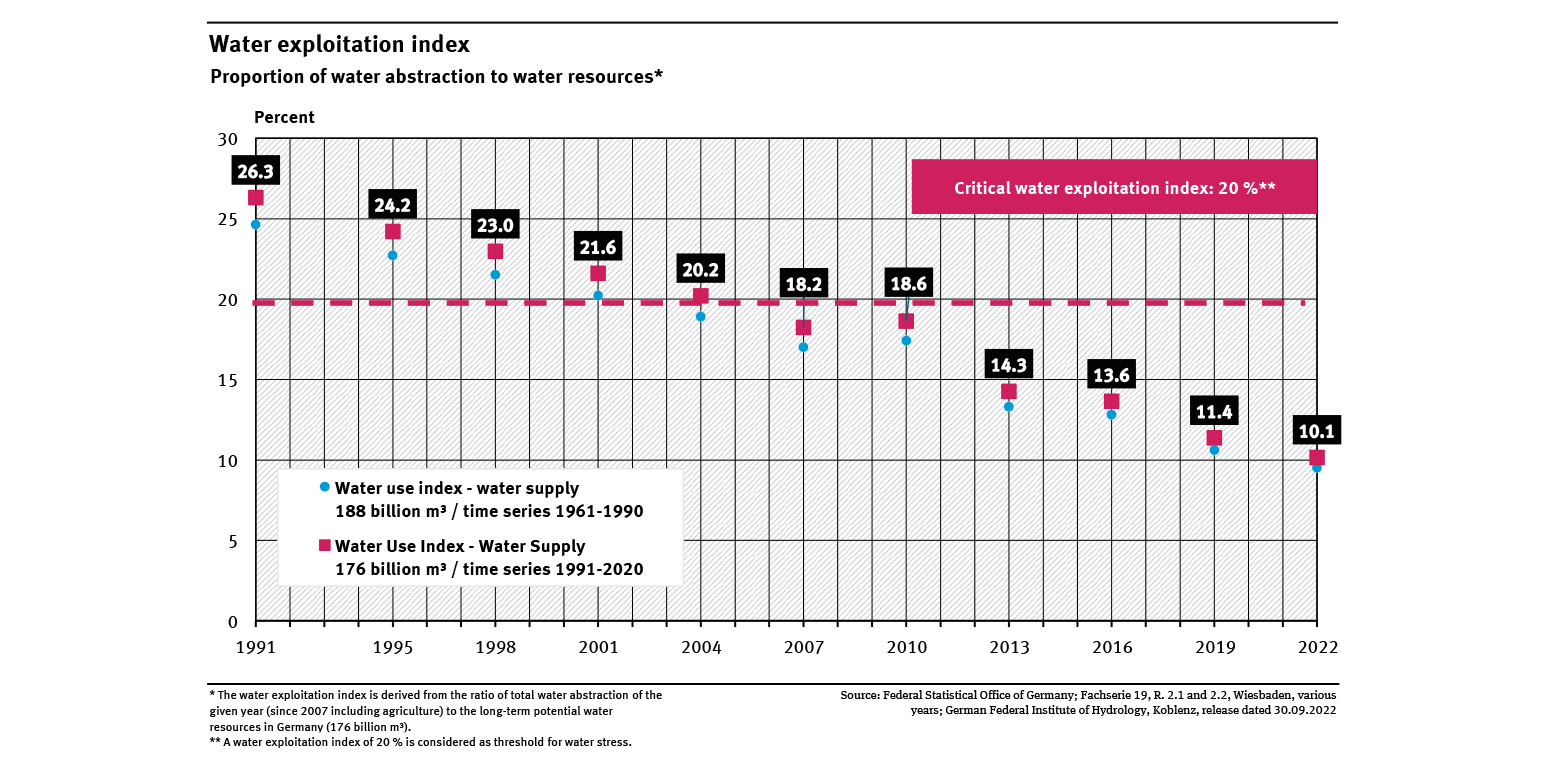
In its Roadmap to a Resource Efficient Europe the European Commission has set a target of not exceeding the 20 % threshold value for the water exploitation index (EC 2011). In Germany the index fell from 26.3 % to 10.1 % between 1991 and 2022. The reason for this development is a continuous decline in water abstraction. In 1991 it was still 46.3 billion cubic metres (m³) while in 2022 with17.9 billion m³ it was significantly lower.
Large amounts of the water volume are being used for cooling and are then returned into lakes or rivers. If this is included in the calculation, then the water exploitation index would be considerably below 10 %. The abstractions for the energy supply are clearly declining since 2013. From 2019 to 2022 the abstractions were reduced by nearly 2 billion m³ from 8.8 to 6.9 billion m³. This clear decline is largely due to the lower use of cooling water in conventional coal and nuclear power plants. However, other water usages (e.g. cooling of data centres, hydrogen production) could lead to a renewed increase of water abstractions. Irrigation demand in agriculture is expected to increase with global warming.
In Germany itself, there is no water stress on average. However, the German economy contributes to water usage in other countries through the import of water-intensive goods. This can cause water stress in some places, depending on the local conditions (Bunsen et al. 2022, in German only).