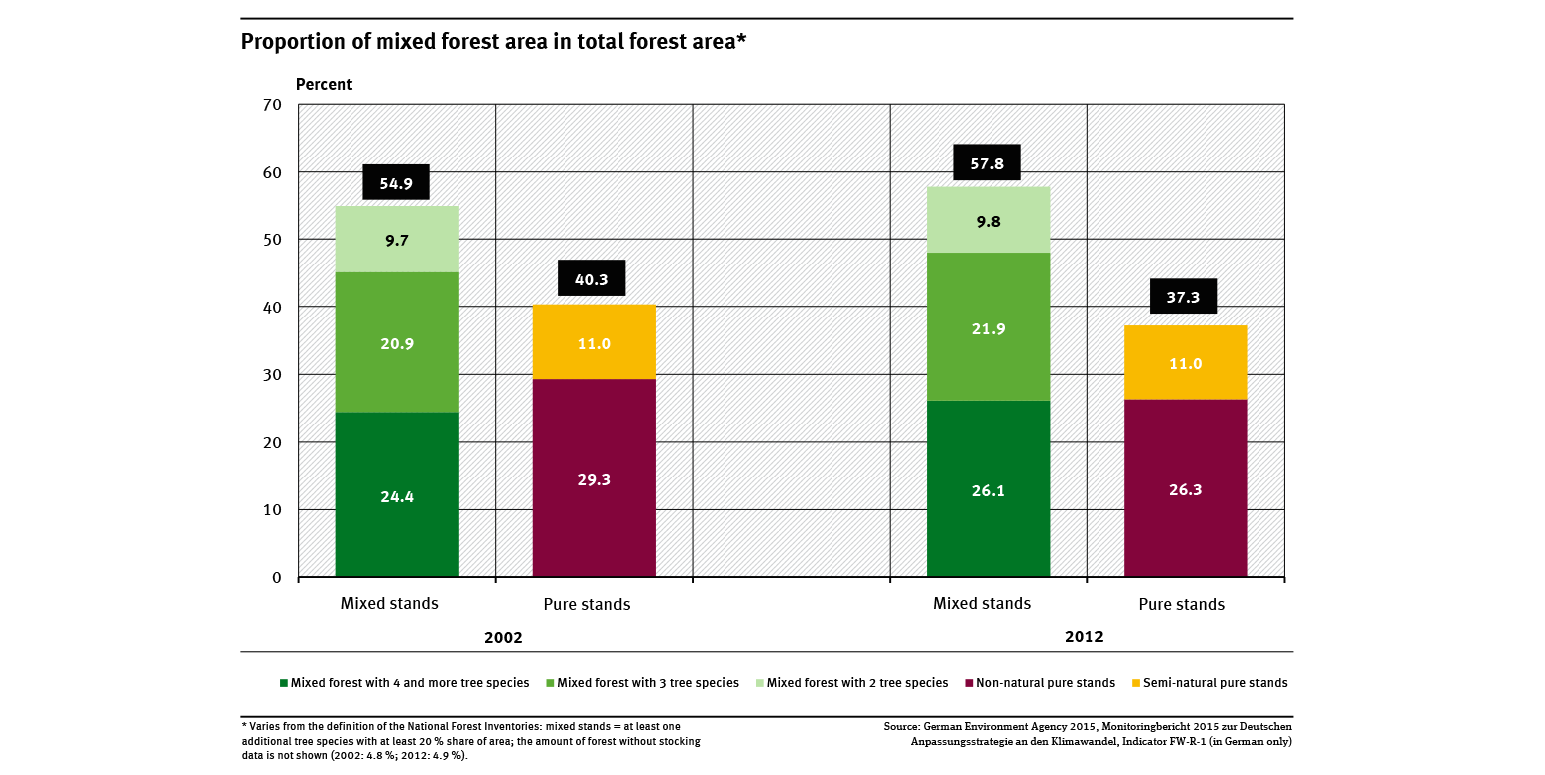
Woodlands cover around a third of the surface of Germany. Besides providing timber, they fulfil various functions for the environment, such as purifying the air, providing a habitat for many species of plants and animals, protecting the soil, etc. The forest therefore needs to be as vigorous and robust as possible.
However, in recent years, it has become increasingly obvious that monocultures are particularly susceptible. This relates in particular to changing site conditions, such as those caused by climate change. These woodlands are therefore at increased risk of losing their protective and compensatory functions. Mixed cultures with a larger number of tree species with differing characteristics and requirements increase structural and genetic diversity. Semi-natural mixed stands also provide a habitat for typical species of woodland plants and animals.
However, mixtures are not automatically valuable in terms of nature and environmental conservation. Mixed stands can also be made up of tree species which do not correspond to the natural forest community or are not adapted to the site.