
Skip to main content Skip to main menu Skip to footer

Power and Heat Generation

The environmental impacts of electric power and heat generation heavily depend on the power or heat generation technology deployed, i.e. the energy source used to produce electricity or heat. Generally, the environmental costs per unit of electric power or heat (per kilowatt hour) are significantly lower for renewable energy sources than for fossil energy sources.

Value factors for electric power and heat generation are determined by using emission factors from the German Environment Agency to assess the direct and indirect greenhouse gas and air pollutant emissions per kilowatt hour for different energy sources. These emission factors are weighted with the value factors for GHG and air pollutant emissions. The value factors in the tables below are averages, following a generic, national-level approach.
Two value factors are provided for each energy source – one using a 0 percent Pure Rate of Time Preference (PRTP) (corresponds to an equal weighting of current and future welfare) and one using a 1 percent PRTP (corresponds to a higher weight on current welfare) for GHG emissions.
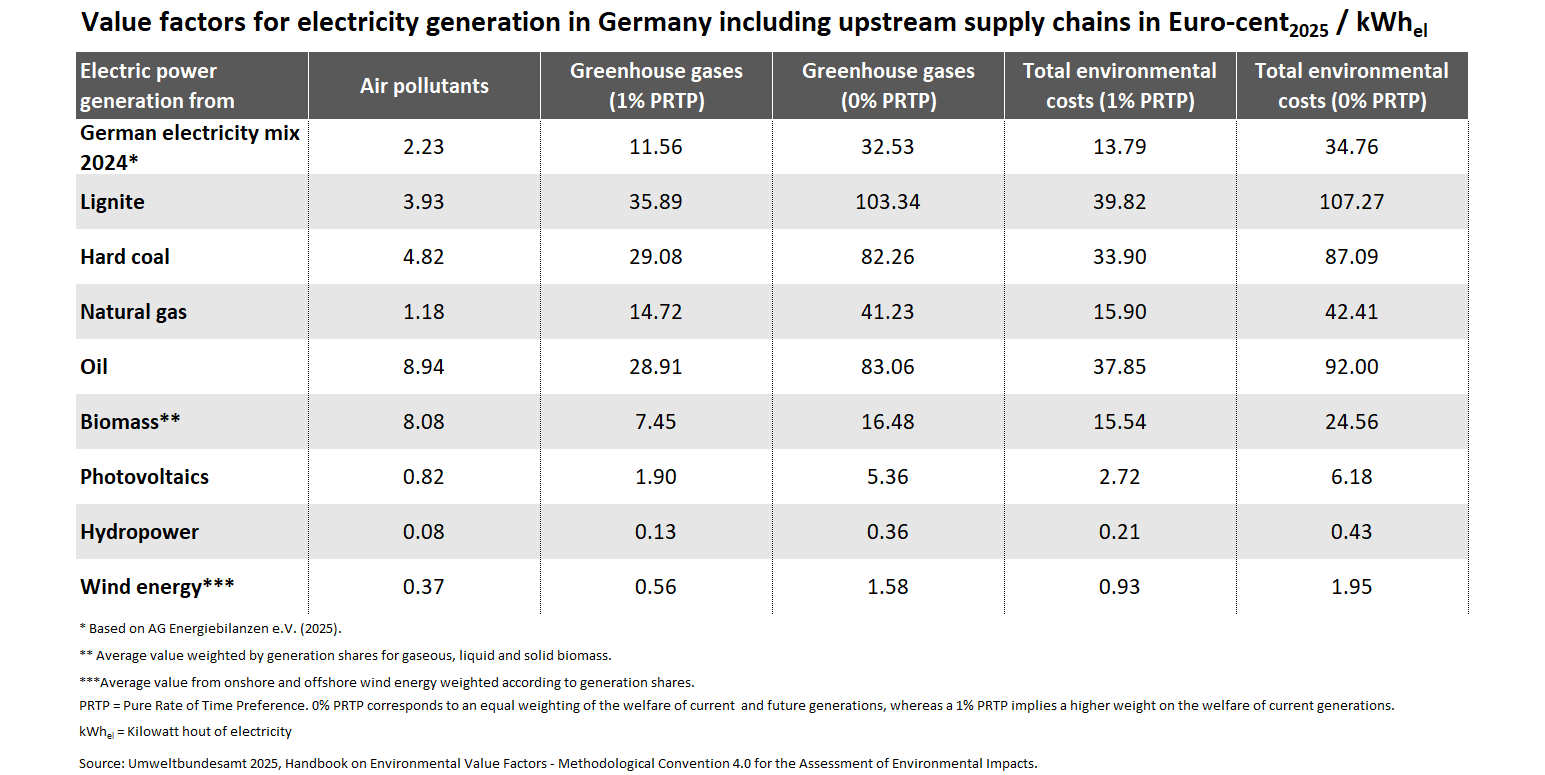
Table illustrates value factors for greenhouse gas and air pollution related environmental impacts from power generation for different energy sources. Value factors for greenhouse gas & air pollution related environmental impacts from power generation

Greenhouse gas and air pollution related environmental impacts from power generation strongly depend on energy source. Value factors range from 0.43 €-cent/kWh to 107 €-cent/kWh.

Source: Umweltbundesamt

Downloads:

More detailed information can be found in Chapter 4 of the Handbook on Environmental Value Factors – Methodological Convention 4.0 for the Assessment of Environmental Impacts.

Back to the home page of the ‘Value factors for the Monetization of Environmental Impacts’ portal

Associated content

Publications

Tags

Short link: https://www.uba.de/n120931en