
Greenhouse gas data reveals the need for fresh momentum in climate action
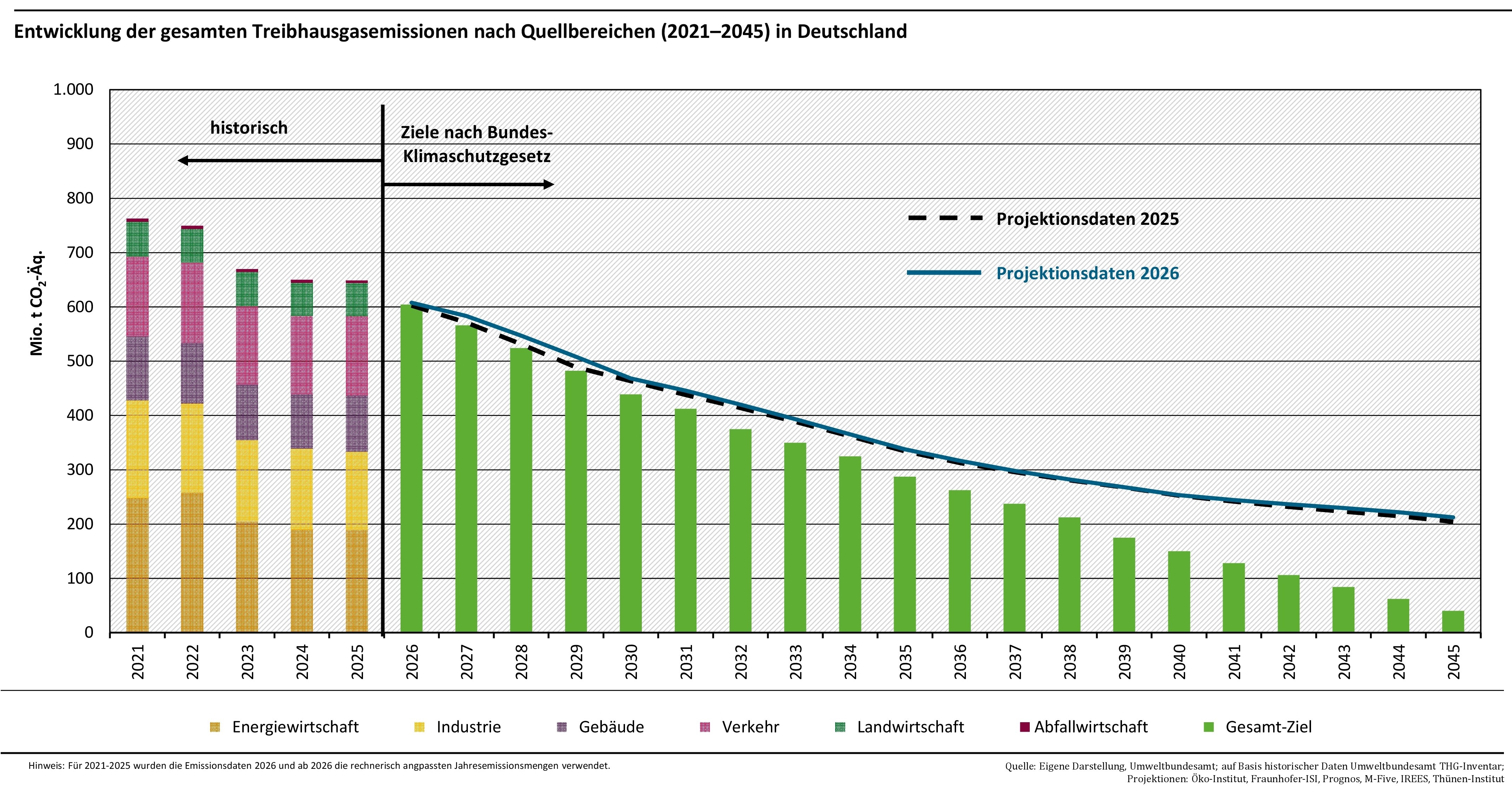
The decline in climate-harming emissions in Germany has slowed. This is shown by the emissions data published by the German Environment Agency (UBA) for 2025. According to these figures, Germany emitted around 649 million tonnes of CO₂ equivalents last year. Emissions fell by just under one million tonnes of CO₂ equivalents, or 0.1 percent, compared to 2024. This means Germany has reduced its greenhouse gas emissions by 48 percent since 1990. The energy sector recorded a decrease of 0.6 million tonnes of CO₂ equivalents, which is also attributable to the renewed increase in electricity generation from renewable energy sources. In the transport and buildings sectors, emissions increased compared to the previous year. At the same time, however, Germany’s forests have recovered to such an extent that they are once again absorbing more CO₂ than they emit. Overall, emissions in 2025 are below the annual emissions budget stipulated by the Climate Protection Act (KSG). The goal of the act – reducing greenhouse gas emissions by 65 percent from 1990 to 2030 – remains achievable, according to the current projection of medium-term greenhouse gas trends. However, this will require additional climate action measures. From 2026 onward, emissions would have to fall by an average of 42 million tonnes of CO₂ equivalents per year through 2030.
Federal Environment Minister Carsten Schneider: “Germany has already made substantial progress on the path to climate neutrality, reducing greenhouse gas emissions by around 48 percent since 1990. Without the progress made in the past, we would today be even more dependent on oil and gas imports. A look back at 2025 reveals a mixed picture. Progress on emissions was too slow. At the same time, we can see increased acceptance of climate action technologies: Demand for electric cars and heat pumps increased enormously in 2025. And there are more newly approved wind power projects than ever before. This gives hope that progress will pick up again in the coming years. What’s more, Germany’s forests helped us with climate action again in 2025. We want to build on these developments and, with the Federal Government’s climate action programme, ensure that Germany gets back on track for climate action. Today, Germany has the technological tools to link climate action, economic dynamism and better living conditions. And what benefits the climate also increases our security and economic strength. Every additional kilowatt-hour of renewable energy makes our country more independent of oil and gas and makes our energy supply more secure.”
UBA President Dirk Messner: “The emissions and projection data show that climate action across sectors has slowed slightly. The good news: We know what needs to be done to still meet the national climate targets, and the course can be set for this at the end of March with the Federal Government’s climate action programme. The central foundation is still a successful energy transition, with a continued strong expansion of renewable energy, the storage and grid infrastructure required for this, and electrification in transport and buildings, as well as a targeted ramp-up of the hydrogen economy.”
Overall, greenhouse gas emissions fell by 0.9 million tonnes of CO₂ equivalents last year, or 0.1 percent from 2024. As a result, the cumulative emissions in 2025 totalling 648.9 million tonnes of CO₂ equivalents are around 12.8 million tonnes of CO₂ equivalents below the permissible annual total of 661.6 million tonnes of CO₂ equivalents, as adjusted in line with the Climate Protection Act (KSG).
The decline in emissions in the industrial sector in 2025, linked to the currently weak economic situation (-5.7 million tonnes of CO₂ equivalents), is offset by almost equally large increases in the transport (+2.1 million tonnes of CO₂ equivalents) and buildings sectors (+3.4 million tonnes of CO₂ equivalents). Emissions remained virtually unchanged in the energy sector (-0.6 million tonnes of CO₂ equivalents) and in agriculture (+/-0 million tonnes of CO₂ equivalents).
Projection data: 2030 climate target remains achievable
Alongside the 2025 emissions data, the UBA is publishing the greenhouse gas projection for the coming years with the 2026 projection data. The projection is based on information available up to November 2025 and therefore does not yet include any new measures by the current Federal Government, nor current developments in oil and gas prices. The projection data shows that the goal of cutting greenhouse gas emissions by 65 percent from 1990 to 2030 remains achievable.
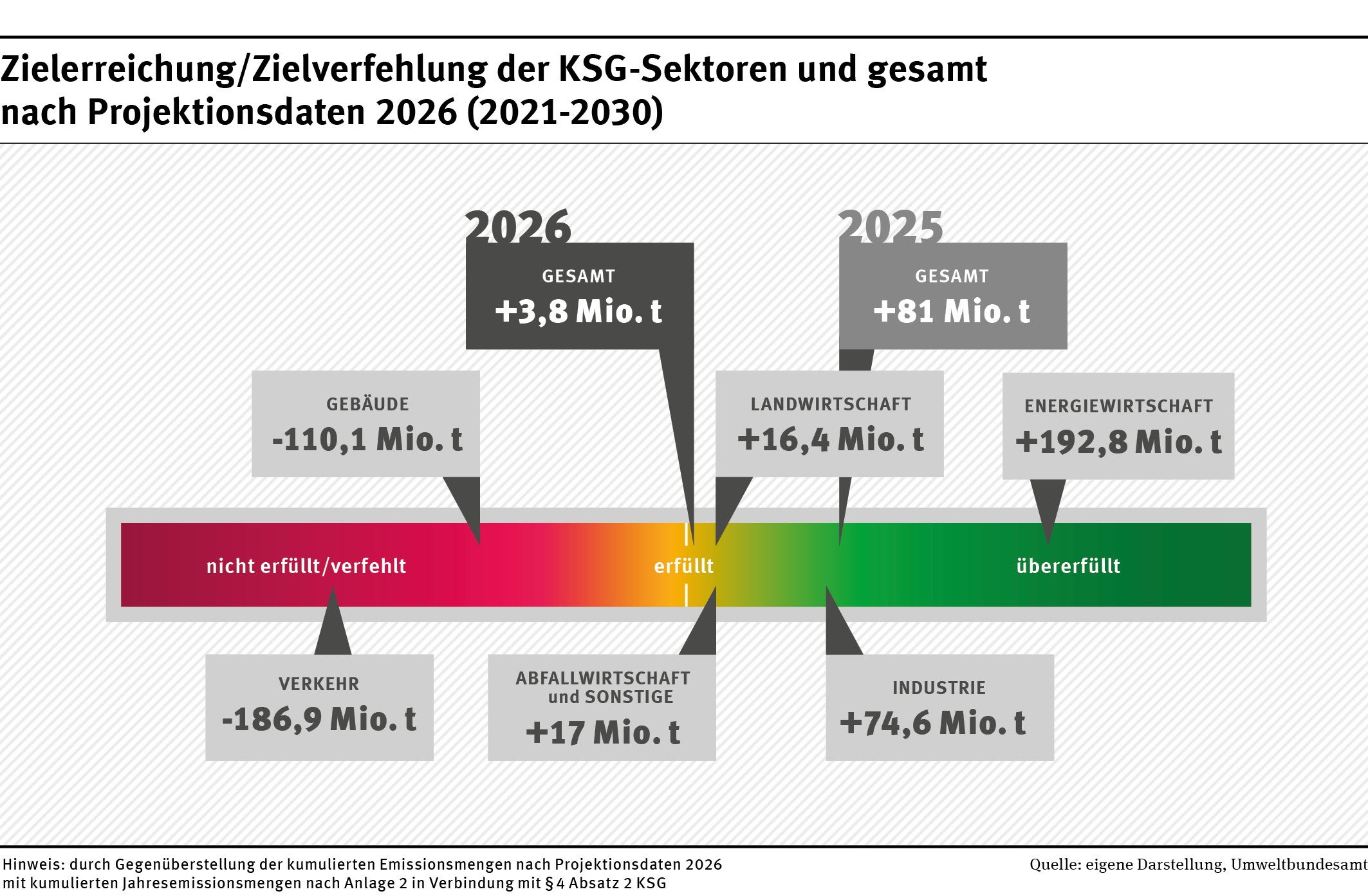
However, the climate policy instruments implemented up to November 2025 are only sufficient to reduce emissions by 62.6 percent by 2030. For the period from 2021 to 2030, the cross-sectoral annual emissions budgets under the KSG are met, in purely arithmetic terms, with a margin of just under 3.8 million tonnes of CO₂ equivalents. Compared with the 2025 projection data, cross-sectoral overachievement has declined significantly and the previous buffer of around 81 million tonnes of CO₂ equivalents has been almost used up.
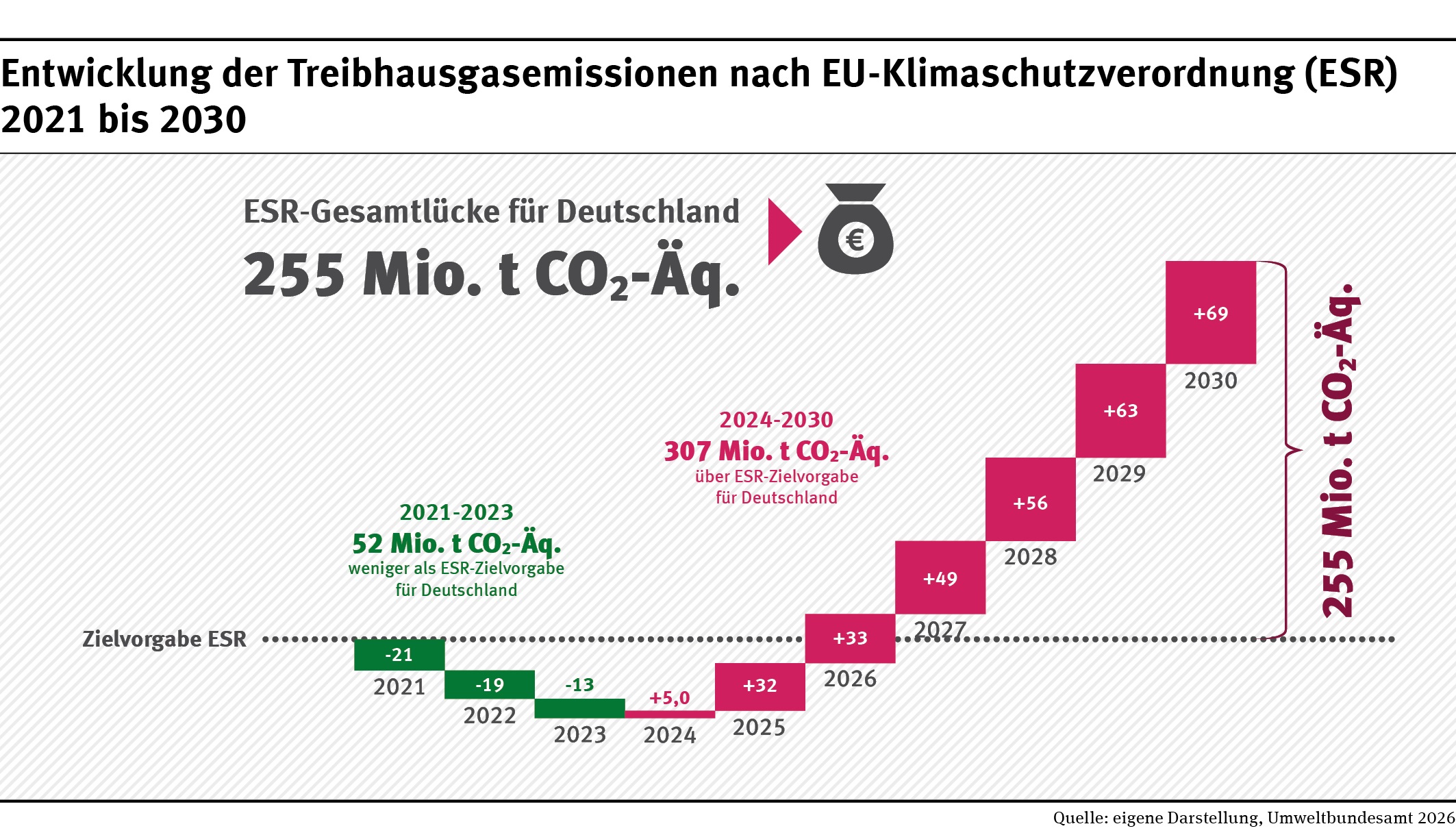
With regard to the obligations under the EU Effort Sharing Regulation (ESR), the total cumulative gap between 2021 and 2030 increases by 29 million tonnes compared with the previous year, to 255 million tonnes of CO₂ equivalents, according to the projection. Investments that free buildings and transport in Germany from dependence on fossil fuels are therefore particularly urgent in order to minimise the purchase of certificates from other EU Member States.
Major action needed in the transport and buildings sectors
In 2025, emissions from the energy sector, at around 189.1 million tonnes of CO₂ equivalents, were 0.6 million tonnes (-0.3 percent) lower than in the previous year. The energy sector is the linchpin of the cross-sectoral transformation. While expansion of wind power and, in particular, solar power made significant progress in 2025, less wind-generated electricity was produced than in the previous year due to the low winds in the first half of the year. A record was set for new wind turbine permits, at almost 21 gigawatts. In addition, the Federal Network Agency was able to complete the approval procedures for 2,000 kilometres of power lines.
The transport sector emitted 146.3 million t of CO₂ equivalents in 2025 (+2.1 million tonnes of CO₂ equivalents). At the same time, there were positive developments in electric mobility that could develop into a larger trend: Germany now has a well-developed public charging network with more than 180,000 charging points, and it continues to grow significantly. Almost one in five newly registered passenger cars was a fully battery-electric vehicle, 45 percent more than in 2024. This momentum could continue this year, with new, more affordable models and the Federal Government’s new support scheme for electric cars.
In the industrial sector emissions from industry fell in 2025 due to the currently weak economy, to 144.1 million tonnes of CO₂ equivalents. This corresponds to a decrease of 5.6 million tonnes of CO₂ equivalents (-3.8 percent) from the previous year. A key reason for this development was lower production volumes in energy-intensive industries and reduced use of fossil energy sources. In the long term, the transformation of industry will be shaped primarily by the following technologies: electrification of industrial processes, the use of green hydrogen, and low-CO₂ production processes (e.g. direct reduction in the steel industry). The ramp-up of these technologies is still not progressing fast enough.
There is still a major need for action in the buildings sector. Emissions in 2025 were 103.4 million tonnes of CO₂ equivalents, which corresponds to an increase of 3.4 million tonnes of CO₂ equivalents, mainly due to cooler weather during the heating season. Although the pace of the shift to climate-friendly energy sources was still too low, acceptance of the climate-friendly heat pump has increased markedly: In 2025, heat pumps overtook gas boilers as the best-selling type of heating system. 299,000 units were sold, 55 percent more than in the previous year. Technological progress, lower operating costs and increasing installation capacities in the skilled trades are driving this development.
The agriculture and waste management sectors show only minor changes compared with 2024.
Forest once again becomes a net sink for greenhouse gases
The land use, land-use change and forestry (LULUCF) sector caused net emissions totalling 26.9 million tonnes of CO₂ equivalents in 2025 (previous year: 57.6 million tonnes of CO₂ equivalents) and thus continues to be a significant net source of greenhouse gases. However, the current emissions data show that Germany’s forest has recovered somewhat after the dry years between 2018 and 2023 and, in 2025, can absorb more CO₂ than it emits (net sink). According to these figures, last year the forest absorbed 19.3 million t of CO₂ equivalents more than it emitted. But as in the previous year, the projection data shows that additional measures are needed to meet the intended sink targets for 2030, 2040 and 2045. Technical negative emissions could also play a role here.
Across multiple sectors, further rafts of measures will also be required in the coming years and decades in order to successfully complete the restructuring of the economy towards climate neutrality. Based on the measures already implemented, a reduction of around 80 percent compared to 1990 will be achieved by 2040, and around 83 percent by 2045.
Further information:
The emissions data available for 2025 represent the best possible estimate at present. In particular, because the statistical calculation bases available at this point are only limited, they are associated with corresponding uncertainties. The calculations are derived from a system of model calculations and trend extrapolations based on the detailed greenhouse gas emissions inventories for 2024 published in January 2026. The UBA will publish the full, official and detailed inventory data on emissions in Germany for 2025 in January 2027 when they are submitted to the European Commission.
To compile the projection data, the UBA regularly commissions an independent research consortium which, in cooperation with the Thünen Institute, uses an integrated modelling approach to estimate how current climate policy affects Germany’s greenhouse gas emissions. The focus is on sectoral results up to 2030 and on the year 2050. The UBA coordinates the work in close consultation with the responsible ministries at federal level for all sectors (energy, transport, industry, buildings, waste management, agriculture, and land use, land-use change and forestry).
The UBA publishes the calculations for the 2025 emissions data. In addition, the UBA is publishing a brief paper on the key findings from the 2025 projection data, “Greenhouse Gas Projections 2026 – Results at a Glance”, as well as further accompanying publications to support understanding of the projection data, provide model documentation for transparency in the calculations, and make a wide range of data available.
Associated content
Links
- UBA press background information: 2025 emissions data and 2026 projection data
- BMUKN press background information: emissions and technology trends
- UBA brief paper on the current projection data “Greenhouse Gas Projections 2026…
- Emissions data in the UBA DataCube
- Projection data in the UBA DataCube
- UBA infographics for download