In the past, the political focus in the building sector prioritised the provision of sufficient and affordable housing. However, the energy transition currently experienced, made it necessary to include the objective of a successive development of climate-neutral building stock by means of energy-efficient building and refurbishing activities. In recent years, the adaptation to climate change has also become more and more essential with respect to a broad range of issues in town planning and the building sector in general. Dry and hot summers such as 2018 and 2019 as well as incidents of heavy rain in numerous locations have increased public awareness of the fact that buildings, villages and towns/cities have to become more resilient to cope with the impacts of climate change.
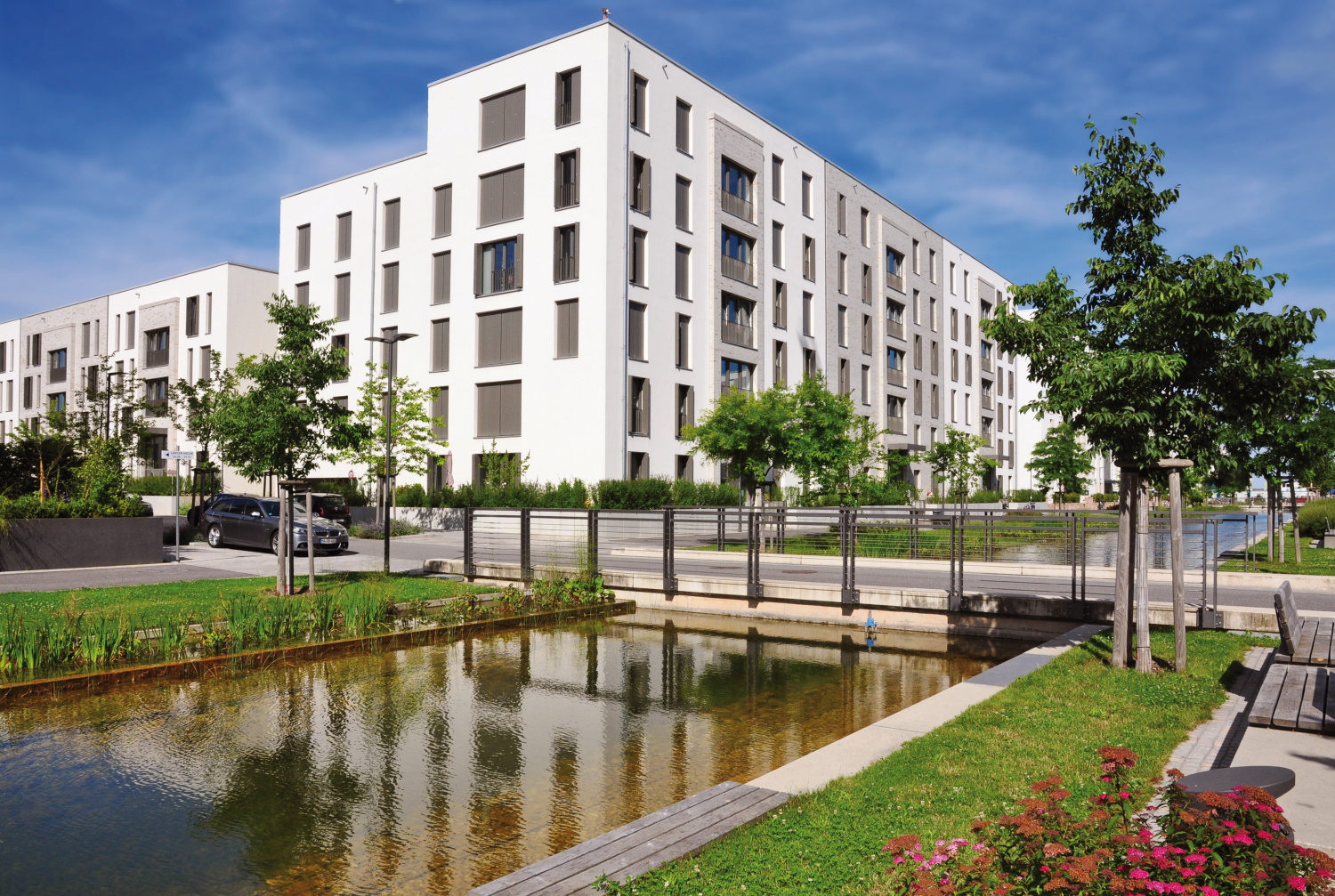
In urban areas it is essential to ensure close coordination of any developments in terms of building planning and design at urban, district and infrastructure levels. If town planning is well adapted to climate issues, it will provide ample green and blue spaces in its infrastructure thus offering the basic requirements for a healthy urban climate that facilitates lower stress even when hot or dry weather prevails. Owing to their intense urbanisation, cities face challenges in terms of maintaining or creating spaces which are conducive to urban climate balance and recreation (cf. Indicator BAU-R-1). Sufficient green structures and water structures also function as important components in the concept of a ‘sponge city’. The term signifies a type of rainwater management which entails, for instance, the creation of retention capacities in municipal parks and other suitable areas where rainwater is stored as close to the location as possible, thus making it available for reuse or for letting it seep into the aquifer or ultimately letting it drain into sewer systems. In case of heavy rain, areas available for flooding help to reduce pressure on the sewage system and to avoid the inundation of settlement areas. At the same time. water retained temporarily on those surfaces increases the effect of cooling by evaporation thus creating a reservoir which, in drought situations, can supplement the grey water supply to municipal green spaces.
The Federal Government supports climate-compatible town planning and development in a variety of ways: In their research projects – the Federal Institute for Research on Building, Urban Affairs and Spatial Development (BBSR) as well as the BMBF and the UBA – address issues in respect of research on climate adaptation and urban development. The direct exchange of communications with pilot municipalities is an elementary part of these projects, and their outcomes are regularly made available to towns, cities and municipalities. In recent years, special emphasis was placed on a more precise ascertainment of the volume and quality of urban verdure and its effect on the urban climate. In addition, municipal strategies for the safeguarding and development of urban verdure were assessed. The motivation underlying various activities does not need to arise from climate adaptation, because urban verdure also provides a number of positive effects for health, active mobility, social cohesion and biological diversity (cf. the strategy process for the White Paper ‘Weißbuch Stadtgrün’132). In addition to technical and methodological assistance in terms of research projects, the Federal Government and Federal States also support climate-compatible urban development by means of promotional programmes: In the summer of 2022, the Federal Ministry for Housing, Urban Development and Building (BMWSB) started the Federal Programme entitled ‘Anpassung urbaner Räume an den Klimawandel’/ ‘Adaptation of urban spaces to climate change’ which promotes projects targeting the maintenance and development of publicly accessible green and open spaces. Within the framework of DAS the BMUV launched a programme entitled ‘Measures for Adaptation to Impacts of Climate Change’ primarily in order to support municipalities and municipal institutions in their efforts to adapt to climate change. Opportunities for advice, continued professional development and networking in the field of climate adaptation are offered to competent persons and stakeholders in municipalities as well as bodies responsible for social services. These opportunities are provided by the Centre for Climate Adaptation / Zentrum KlimaAnpassung (www.zentrum-klimaanpassung.de), founded in 2021 by the BMUV.
In the same way as adapted town planning, climate-compatible continued-development of the building stock is addressed by research and development. An important theme in this context is the greening of façades and roof spaces. Numerous town and municipalities promote the greening of buildings (cf. Indicator BAU-R-2). Opportunities for support are already available from Federal Government.133 Besides, in research and development emphasis is placed on heat protection of buildings in summer, which – if planned correctly – can have synergetic effects on climate protection and adaptation (cf. Indicator BAU-R-3). In view of ongoing climate warming, heat protection in summer is gaining ever more importance for the quality of functionality and ambience in both public and private buildings. Another theme that requires to be addressed by research is the need to adapt structural norms or standards and regulations to changed climatic conditions so that climate adaptation is integrated from the outset in planning and construction of buildings.134 In order to reinforce the role-model function of public buildings in terms of climate adaptation, the Assessment System for Sustainable Building (BNB) is currently being developed further, with the aim to facilitate the quality assessment of planning and building performances in respect of climate-compatible building outcomes, which can then be reflected in the certification system.
130 - Meinel G., Krüger T., Eichler L., Wurm, Michael, Tenikl, Julia, Frick A., Wagner K., Fina S. 2022: Wie grün sind deutsche Städte? Ergebnisse einer bundesweiten Erfassung. Bundesinstitut für Bau- Stadt- und Raumforschung (BBSR) im Bundesamt für Bauwesen und Raumordnung (BBR). Bonn, 62 pp. https://www.bbsr.bund.de/BBSR/DE/veroeffentlichungen/sonderveroeffentlichungen/2022/wie-gruen-deutsche-staedte.html.
131 - Meinel et al. 2022, cf. endnote no. 130.
132 - BMUB – Bundesministerium für Umwelt, Naturschutz, Bau und Reaktorsicherheit (Hg.) 2017: Weißbuch Stadtgrün – Grün in der Stadt – Für eine lebenswerte Zukunft. Berlin, 51 pp. https://www.bbsr.bund.de/BBSR/DE/veroeffentlichungen/ministerien/bmub/verschiedene-themen/2017/weissbuch-stadtgruen.html.
133 - Mann G., Fischer B., Fischer S., Gohlke R., Mollenhauer F., Wolff F., Köhler M., Pfoser N. 2022: Förderrichtlinie Dach- und Fassadenbegrünung – Machbarkeitsstudie. Bundesinstitut für Bau-, Stadt- und Raumforschung am Bundesamt für Bauordnung und Raumwesen (Hg.). 105 pp. https://www.bbsr.bund.de/BBSR/DE/forschung/programme/weitere/gruen-in-der-stadt/machbarkeitsstudie-gebaeudegruen/endbericht.pdf.
134 - Kind C., Golz S., Sieker H. 2022: Klimaanpassung und Normungsverfahren. Analyse bestehender bautechnischer Normen und Regelwerke für einen Anpassungsbedarf an die Folgen des Klimawandels. 85 pp. https://www.bbsr.bund.de/BBSR/DE/forschung/programme/zb/Auftragsforschung/5EnergieKlimaBauen/2019/klimaanpassung/endbericht.pdf.