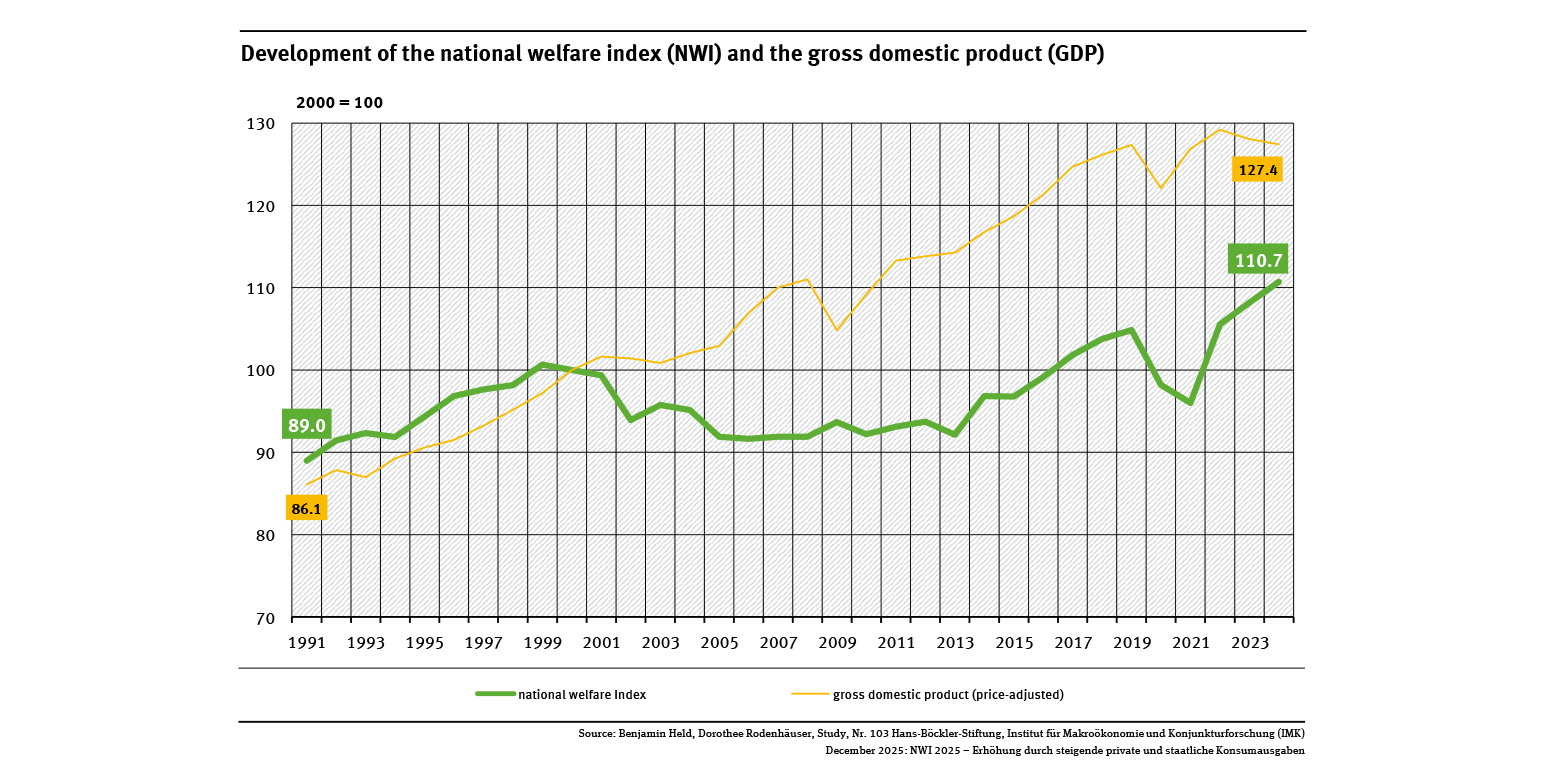
The development of the NWI since 1991 shows different trends. Until 1999 a continuous increase parallel to GDP can be observed. This is followed by a disparity: While GDP continues to rise, the NWI falls. The main cause was the increasing income inequality. Between 2005 and 2013 there were hardly any fluctuations of the NWI. From 2014 on there was a positive trend. Consumer spending increased, inequality stagnated and environmental costs decreased slightly. In the pandemic year, however, both GDP and NWI fell abruptly. Whereas the GDP recovered in 2021, particularly the floods on the Ahr and Erft rivers caused the NWI to drop further. In 2022, there was a strong increase due to rising consumer spending (also due to the relief packages), energy savings and lower damage from natural disasters compared to the previous year.
The NWI increased in 2023 and 2024. There was a further decrease in pollution, mainly due to falling energy consumption and the expansion of renewable energy and the associated lower emissions. There was also a slight increase in consumption. Early estimates based on developments in the first half of the year suggest a similar trend in 2025. A further increase of the NWI in 2025 will therefore probably occur. You will find more information in a recent detailed analysis of the NWI (in German only) .